Scroll down for a transcription of this episode.
There’s a tapping practice shown to ease stress, balance emotions, and support healing. We explore the science behind Emotional Freedom Technique, or EFT.
Summary: Emerging research shows that a body-tapping technique called Emotional Freedom Technique, or EFT, can help calm the nervous system, improve emotional awareness, and support healing from trauma. In this episode of The Science of Happiness, we follow illustrator Minnie Phan's journey of using this evidence-based practice to connect with herself, care for her mental health, and create from a place of resilience.
How To Do This Practice:
- Identify the issue: Choose one specific feeling, thought, or physical sensation that’s bothering you, such as stress, sadness, or tension in your body.
- Rate the intensity: On a scale of 0 to 10 (with 10 being the most intense), rate how strongly you feel it right now. This will help you notice changes as you tap.
- Create your setup statement: Say a phrase that names your feeling and affirms self-acceptance, such as: "Even though I feel anxious, I fully and completely accept myself."
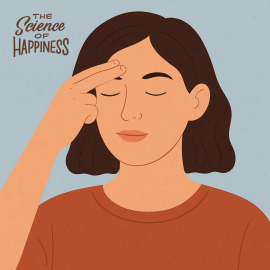
- Gently tap 5–7 times on each point: Side of hand, inner eyebrow above your nose, side of eye, under eye, under nose, chin, collarbone, under arm, and top of head.
- Repeat while tapping: As you tap each point, repeat a shortened reminder phrase (e.g., “I feel anxious” or “I accept myself”) while taking slow, steady breaths.
- Reassess and repeat if needed: Pause, take a breath, and rate your intensity again. Continue another round or two until you notice a shift toward more calm or ease.
Today’s Guests:
MINNIE PHAN is an illustrator and publisher of the picture book, The Yellow Áo Dài. Phan has also collaborated with Pulitzer Prize winning author Viet Thanh Nguyen on the book, Simone.
Learn more about Minnie Phan here: https://www.minniephan.com/
Follow Minnie Phan on Instagram: @minnie_phan
DR. PETA STAPLETON is a world-leading researcher in the Emotional Freedom Technique.
Learn more about Dr. Peta Stapleton here: https://www.petastapleton.com/
Follow Dr. Peta Stapleton on LinkedIn: @petastapleton
Related The Science of Happiness episodes:
How Holding Yourself Can Reduce Stress: https://tinyurl.com/2hvhkwe6
The Science of Humming: https://tinyurl.com/4esyy6nd
How To Tune Out The Noise: https://tinyurl.com/4hhekjuh
Related Happiness Breaks:
Tap into the Joy That Surrounds You: https://tinyurl.com/2pb8ye9x
The Healing Power of Your Own Touch: https://tinyurl.com/y4ze59h8
Make Uncertainty Part of the Process: https://tinyurl.com/234u5ds7
Tell us about your experience with this practice. Email us at happinesspod@berkeley.edu or follow on Instagram @HappinessPod.
Help us share The Science of Happiness! Leave us a 5-star review on Apple Podcasts and share this link with someone who might like the show: https://tinyurl.com/2p9h5aap
Transcription:
MINNIE PHAN: I went to five elementary schools, and though my environment constantly changed when I was a child, one thing stayed consistent, and that was access to a piece of paper and a pencil. No matter where I lived, no matter who was around me, I could always draw. I think drawing was a way for me to see myself and to be with myself in a way that was safe and comforting, and it was the one place, one thing that I could control in a life where I felt very powerless, being a child is a powerless experience, especially being the daughter of refugees, where parents were doing their absolute best to survive in this country without knowing the language, the culture and also not having any real formal education. Being an artist requires a deep connection to one's self, one's child self. I think being an artist is opening doors to parts of yourself that people I think are really terrified of, their needs, their curiosities, their hungers. And I recently found myself in a really intense place where I felt so opened up, but also so emotionally creatively charged. And I was ready to just dive in, but I found that I wasn't really taking care of myself during my most heightened emotional places, and so EFT has been a way of grounding myself and caring for myself while I'm doing the work of creativity and expression, tapping started to bring me back to my physical experience, something to focus on that was outside my mind.
SHUKA KALANTARI: For 1000s of years, Chinese medicine has worked with the body's energetic pathways, using techniques like acupuncture to support healing. A more recent approach works with those same pathways through tapping. I'm Shuka Kalantari. Welcome to The Science of Happiness. Today we're exploring Emotional Freedom Technique, or EFT. It draws from traditional Chinese medicine, modern psychology and the science of neuroplasticity, and it's gaining attention for how it can help us with stress, anxiety, pain, sleep, and even our immune system for our show. Illustrator, Minnie Phan, tried it out.
MINNIE PHAN: Gosh, everyone should do EFT. I really feel that. I really, I really believe that it has profound ability for us to know ourselves better.
SHUKA KALANTARI: Later, we'll hear from Dr Peter Stapleton, she's a world leading researcher on EFT.
DR. PETA STAPLETON: Tapping is a stress reduction technique where we know cortisol will respond. We know that the brainwave EEG research that has been done will show that the brain can come back down into that calm state.
SHUKA KALANTARI: Stay with us. Welcome back to The Science of Happiness. I'm Shuka Kalantari. Today we're hearing from Illustrator Minnie Phan. She's published two beautiful picture books, The Yellow Áo Dài , about a little girl who connects to her Vietnamese heritage, and also Simone, a collaboration she did with Pulitzer Prize winning author Viet Thanh Nguyen. Minnie spoke with Dacher Keltner about how emotional freedom technique has helped her ground. Here's part of their conversation.
DACHER KELTNER: Minnie, it's so nice to have you on the show.
MINNIE PHAN: Hi, Dacher. It's really nice to be here.
DACHER KELTNER: Being a working artist is hard. You're balancing a lot, finding work, paying your rent, et cetera, and in the challenge of creativity. And it's interesting that you chose this tapping exercise known as Emotional Freedom Technique. I've been hearing a lot about it, so I'm really eager to know, like, just walk me through. What is it? What do you do with emotional freedom technique or EFT?
MINNIE PHAN: Okay, so the basic idea is to identify something that's bothering you and to rate it on a scale of one to 10. You repeat what's been bothering you, and then you follow it with the phrase, I fully and completely accept myself. And while you're doing that, you're tapping specific areas of your body. And while you're tapping, you're saying the phrase throughout and taking deep cleansing breaths. So for example, I'm tapping the area under my pinky. I feel nervous, but I fully and completely accept myself.
Now I'm tapping the top of my head.
I feel nervous, but I fully and completely accept myself.
I'm moving on to my face. I feel nervous, but I fully and completely accept myself.
I'm tapping the area under my eye.
I feel nervous, but I fully and completely accept myself.
At the start of the practice, I'm supposed to rate from one to 10 how I feel. At the beginning, I think I felt perhaps a five on the nervous scale, and currently I feel a one on the nervous scale.
DACHER KELTNER: Yeah, I'm feeling pretty calm myself. Thank you, Minnie. There's a lot of research showing that this simple practice of tapping helps nurses with stress during the pandemic. It's helped veterans with PTSD, it helps lower cortisol levels. Even affects regions of the brain like the amygdala. You know, I felt it following your instructions, but what has it been like for you, just in your body and your feeling in terms of the practice?
MINNIE PHAN: It's been incredible, really empowering. I have found myself in moments of distress, trying to just shake it off, trying to push away what I'm going through. But I found that my body was like a magnet to those emotions. I would shake and push, but suddenly all the feelings would come right back and stick on me, if anything, they would stick even more intensely on me that I couldn't just like, oh, like a dog shake and get all the feelings out. As I incorporated tapping techniques, I let myself feel through the emotions and recognize them and sit with them and let them process through me and exit that the channels that they were leaving through the tapping really felt like they were coming out, and it was far more helpful for me to take five minutes to breathe and process and accept myself, rather than reject what I was going through.
DACHER KELTNER: It's so fascinating, Minnie, because we have these bodily responses that are associated with hard emotions like trauma and sadness or grief or pain, rejection, racism, sexism, et cetera, that just rattle the body, and so often we're out of touch with those emotions, and just becoming aware of the body helps us with the hard emotions, like you're saying, it's really powerful. You know, you have a remarkable family story, a story of refugees. The Vietnam War. It was a horror show. It's the 50th anniversary of the war that has just passed. Your family resettled. So much trauma was that part of your experience of EFT is just those stories of your family and being a refugee and that very hard history.
MINNIE PHAN: Absolutely, as I've matured as an artist. I recognize the work that I want to make being an illustrator and writer. I don't want to just be in the capitalist system of trying to pay my bills. I want to tell a larger narrative, a bigger story. And I've always wanted to tell a story about my family, about refugees, about central Vietnamese refugees, especially, we have a totally different dialect than other areas of Vietnam, and I have felt as a minority within a minority. And so I feel very compelled and excited and motivated to tell my family's story, but I could not do that without the tools of processing and understanding trauma, trauma within myself, my family, my community, and the part of EFT that really has made a difference more than the physical aspect of breathing and tapping, is the part when I say that I fully and completely accept myself, and that means I fully and completely accept the situations that my family has experienced, the past of my family, the dynamics of my siblings, that once I'm able to recognize and accept it, then I can move forward with whatever action I want to put forth, whether that's making art or trying to connect, reach out or disengage for self protection or out of genuine love and affection for someone else, because there are times as an artist, I'm so willing to dig into a hard moment, and some people just aren't ready for that, and I think it requires restraint and thoughtfulness and power within oneself to know when silence is necessary and when action is necessary.
DACHER KELTNER: And self protection. I'm just curious if the practice made you think about fundamental beliefs that you have and shift them a bit, just about the mind or about your place in the world. How did this EFT practice influence your beliefs?
MINNIE PHAN: Gosh, everyone should do EFT, I really feel that I really, part of me felt going through the practice that it's a tool that should be for everyone. I really believe that it has profound ability for us to know ourselves better and to know other people better. It's the act of taking a moment to breathe. Through and recognize, pinpoint, identify what you're going through.
DACHER KELTNER: Are you still practicing it today?
MINNIE PHAN: I am.
DACHER KELTNER: And how do you practice it? I love how people will do it while walking or right before bed. Or how do you integrate EFT into your daily routines?
MINNIE PHAN: I actually use EFT a lot at night when I can't sleep. It has definitely helped parts of my insomnia, where just recognizing, again, identifying what I'm feeling and not resisting myself has helped a lot, with sleeping better, with processing the day. I think I'd say I'm more kind to myself because I'm talking to myself a lot more.
DACHER KELTNER: That's fascinating. EFT in the big landscape of practices, there are kind of body practices, the breathing, and the body scan, and, you know, yogic traditions and so forth, Qigong. And then there's the self compassion, World of being kind to yourself. And I'm curious for you how those two things worked, you know, just the tapping of different regions of the body, where the energy flow is, and then saying those kind words to yourself,
MINNIE PHAN: It was very important for me to have a physical element to the practice, because it's easy, especially for artists and creatives, to live in the brain. Tapping started to bring me back to my physical experience, something to focus on that was outside my mind. I'm tapping right now, actually, while I'm telling you this, and I feel so good. It feels so good. It's like, almost like, as I'm tapping my body, I'm saying, Hey, you're still here. Hey, you're alive.
DACHER KELTNER: I hear you. I hear you. We need to remember the body when we're creating wonderful illustrations or scientific findings, and we so often lose them. Thank you.
MINNIE PHAN: Thank you.
SHUKA KALANTARI: Up next, Dr. Peta Stapleton shares more about the science of EFT, how it uses the electrical pathways in our bodies to keep us healthy.
DR. PETA STAPLETON: When we stimulate an acupuncture point through tapping, we can see that electrical signal traveling along that concrete duct system, and we can trace where that ends up in the brain and the body
SHUKA KALANTARI: More after this break. Welcome back to The Science of Happiness. I'm Shuka Kalantari. Dr. Peta Stapleton is one of the leading researchers on Emotional Freedom Technique. She spoke with our producer Truc Nguyen about the science behind how this practice works.
TRUC NGUYEN: Over the years, Dr. Peta Stapleton has led numerous studies on Emotional Freedom Technique, including trials measuring its effects on cortisol, the body's primary stress hormone.
DR. PETA STAPLETON: And we showed significant reductions, up to 45% reductions in one hour of tapping of cortisol.
TRUC NGUYEN: And even eight weeks after the tapping sessions, cortisol levels were still lower.
DR. PETA STAPLETON: We've done chronic pain research, someone's able to reduce cortisol, they then get a positive impact on inflammation and the experience of chronic pain in their bodies.
TRUC NGUYEN: EFT is being used to treat things like PTSD, stress, insomnia and hormonal symptoms from menopause. This simple practice seems to help with a lot of problems. But what's actually happening? Back in the 70s, psychologist Gary Craig developed the emotional freedom technique by adapting acupuncture points from traditional Chinese medicine.
DR. PETA STAPLETON: We do know after many decades of research that the acupuncture system in the body is not just energetic. It is indeed a vascular duct system in the body.
TRUC NGUYEN: This vascular duct is another way our bodies can communicate. When we get acupuncture, put pressure or tap on specific points on our body. That frequency is converted into an electrical signal.
DR. PETA STAPLETON: And of course, we can trace where that ends up in the brain and the body. Now that primovascular system, the meridian system, is able to then move. And the semiconductor there is actually collagen. So collagen has been shown to conduct that tapping sequence into an electrical signal that's able to travel through the body.
TRUC NGUYEN: These points have a lot of collagen, rich connective tissue, and many are associated with different organs.
DR. PETA STAPLETON: So if I give you an example, the one under the eye tends to be associated with the stomach Meridian in Chinese acupuncture. So if someone was tapping there, it may have quite an impact on, you know, butterflies in the stomach, if someone was nervous or anxious,
TRUC NGUYEN: The electrical signal also travels to different parts of the brain, particularly the amygdala, the Brain Stress center. So when Minnie was saying, “I feel nervous, but I fully and completely accept myself.” She was sending a message.
DR. PETA STAPLETON: The words. Giving that electrical signal the power. So the words then are telling the amygdala it's safe, it's okay to come down. We know the prefrontal cortex, in part of that tapping in the electrical signals as well, is also coming back online. So of course, stress, intense stress and trauma makes that prefrontal cortex, or the thinking center in the front of our brains, go offline, so that we can go into fight or flight or freeze or faint, and if it's able to come back online, that's where people then, through the tapping, become calmer, and then might suddenly think I've just thought of a solution to my problem that I was tapping on.
TRUC NGUYEN: We can actually see these signals and our brainwaves changing in real time.
DR. PETA STAPLETON: If we were to brain scan in that exact moment, or indeed, we've done heart rate variability, or, you know, EEG measurements, you see the moment of the brain coming back, or the EEG bands going from, you know, high alpha coming back down into sort of, you know, a delta State, which is more of that kind of calm state.
TRUC NGUYEN: Making a statement gives us a moment to acknowledge and be real with what's going on, and we don't even have to say it out loud.
DR. PETA STAPLETON: We've had meta analysis now that show it is the tapping on an acupuncture point that appears to be the most important active ingredient, because it will work without you, out loud saying what the problem is. You can say it internally, as long as you're present to it. And we do know non verbal adults and children will still get an impact from tapping if they're in a distress state, but don't have words available to them as long as they feel it. The tapping works. If I do an action at the same time that gives my body and brain the opposite feeling state, obviously, that's often calm or neutral, then my brain can't hold the distress state.
TRUC NGUYEN: EFT asks us to pause each moment there's a thought, a body sensation or a hard feeling.
DR. PETA STAPLETON: And then frame by frame, as that whole, if you like, movie is worked through. That's where someone will actually be able to think back to the memory, talk through that movie, and not have any of those levels of distress. And then, of course, in the future, be able to think back and not be triggered and feel like, yes, it happened to me, but no, I'm no longer triggered in the present moment.
TRUC NGUYEN: When we're feeling more safe and regulated, we could also do something called positive tapping.
DR. PETA STAPLETON: Where we may conclude or finish a tapping session with more choices. How would you like to feel now? And you can certainly do positive tapping around feeling calmer now and feeling calmer in the future. If you're faced with a similar situation, we never start there, because it would have a very surface effect, because it wouldn't be acknowledging what's really going on.
SHUKA KALANTARI: Next time on The Science of Happiness, we're exploring the science of touch, how it can help us and the people we care for.
THERESA ALEXANDER: I'm definitely gonna work on the belly rubs and I think the self hugs, especially once she starts pre-K and I'm not there for her to run to. It's like, okay, well, we're gonna hug ourselves and be like, it's okay. I could be a friend to myself, you know, like I'm doing okay.
SHUKA KALANTARI: Thank you for listening to The Science of Happiness. Our associate producers are Emily Brower and Dasha Zerboni. Our producer is Truc Nguyen. Our sound designer is Jennie Cataldo, of Accompany Studios, Dacher Keltner is our host. I'm Shuka Kalantari, the executive producer. Have a beautiful day.



Comments