Kellita Maloof had been dancing since she was young. But she didn’t fully appreciate what dance had given her until she was recovering from a flare up of ulcerative colitis, an autoimmune disorder that affects the gastrointestinal system. Not ballet, which she’d been trained in as a teen, but burlesque, which she discovered in her 30s.
“I started practicing burlesque 25 years ago and it took me a solid 10 years to even understand what I was doing,” says Maloof, who founded the Hot Pink Feathers burlesque troupe in San Francisco in 2000. She continues:
In that time and space [rehabbing], I had profound reflection time at a depth that is not usually available to people for a variety of reasons, and I got it—how I had been using burlesque. In the burlesque act I am practicing being fully associated, being fully present and rather than following a strict choreography, what I am doing is checking in every second and every millisecond, ‘Am I here?’ Am I fully inhabiting my body? Am I choosing actively and consciously in this moment, with these people, do I consent and take joy and pleasure in removing this next layer?’
Maloof’s experience is not unique. In fact, there are lots of anecdotal stories written by women who have turned to burlesque to feel better about themselves—and there’s also a growing body of research.
With origins dating back to ancient Greek satirical plays, burlesque combines dance, music, and parody as a way to both celebrate and ridicule sexuality while also using exaggeration and mockery to make fun of social mores and push boundaries.
As Julia Persky, an assistant professor at East Texas A&M, writes, “For hundreds of years, the art of burlesque has offered to the poor and working classes–the marginalized–a place of entertainment and escape via theatrical presentations.”
When burlesque came to America in the 1800s, it came to be associated more with striptease and other forms of exotic dancing. Since then, it has gone through several iterations and has been discovered and rediscovered until it emerged in the mid-1990s as what’s considered “neo-burlesque.”
Since then, “the art form has embraced and repurposed many of its historical tropes for eager, often queer, and overwhelmingly female audiences,” writes historian Betsy Golden Kellem. “Burlesque resonates for audiences today in its celebration of variable bodies, its conscious ability to play with gender and mock power structures, and its ability to nurture both fun and transformation.” And neo-burlesque is overwhelmingly performed and driven by women and femme-presenting women for women.
While numerous studies highlight the benefits of dance and movement therapy as a way to address trauma, burlesque stands out as a type of dance that focuses on women’s sexual and sexualized body “to understand not only what that means but also what that feels like,” says Jacki Willson, an associate professor in performance and gender at the University of Leeds in the United Kingdom. She’s been studying the dance form for several years.
Burlesque is a safe place to heal from trauma because “it encourages and shares a different self-determination, consent, self-love, and care,” Willson says. “It performs the line between misogyny and sexual agency, between appropriation and self-possession. It does this by drawing on performance moves, techniques, props, and persona/tropes that… give the performer and the audience a new understanding of the way power has been taken away and an evolving palette of theatrical options for taking that power back.”
To be clear, not everyone is drawn to burlesque to heal and not every burlesque instructor approaches it as a healing space. And some may be where Maloof was years ago, unable to articulate or even be aware of their trauma, whether it’s what Maloof calls “boom-boom trauma,” a single event such as a sexual assault, or “drip-drip trauma,” which she says starts with attachment in childhood and results in being “chronically unseen.”
Which is why Maloof presents the lessons she’s been offering since 2010 as conscious burlesque. “It’s possible to consciously and specifically approach it as a coming home,” she says. “Everyone in the room is asking, ‘What does it feel like to be me?’ I’m inviting everyone over and over, what are the body sensations I have as I witness you or as you are being witnessed by me. It’s training us to come home in a very practical sense.”
Burlesque, she says, offers a chance to be fully seen and acknowledged, and that in itself is healing.
Dancing with yourself
That may be why many marginalized people, including gay and lesbian, Black, larger-bodied and people with disabilities, find burlesque as a safe place.
In her doctoral dissertation on current and past Black burlesque performers, Ashley Dunn writes that the dance form is “a site for Black women to redefine, and resist societal limits placed on them.”
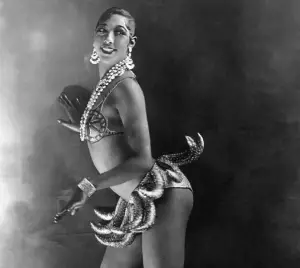 Burlesque pioneer Josephine Baker became a symbol of Black pride and defiance during the 1920s and 1930s.
While Black burlesque performers have been erased from the history of the dance form, she argues, many white performers copied their dance moves: “Black performers have repurposed, reappropriated, and transformed burlesque (the same platform used to appropriate them) into a site to heal from racialized trauma.”
Because burlesque is a dance form that welcomes performers to explore and play with gender, it often celebrates queer identities—identities that increasingly are under attack. One study observes that neo-burlesque functions as a “queer emotional theater… in which emotions and humor offer a temporary liberation from everyday wounds” and that “emotions and their embodiment in the performance of neo-burlesque offer a queer theatrical purgation, a temporary relief from everyday structures, and playful rewriting of these structures, both for performers and the audience.”
Laura C. Westmoreland, a therapist in Los Angeles, was drawn to burlesque after seeing performances by Dita von Teese, considered the queen of burlesque. “I was so impressed and amazed by the diversity of the performers,” she says. “I could see myself in some of the performers.
After taking private lessons, Westmoreland noticed a shift in how she viewed herself. “I was making eye contact with myself, a moment of extreme connection with myself—physically, emotionally, and it was like, whoa, what just happened here?”
It prompted her to focus her doctoral dissertation on the healing power of recreational burlesque. “As self-identified women, we move through this world and many of us have a separation between the mind-body just to be safe in this world, so what if there’s a space where we can engage in these sensual movements and feel safe and reconnected to our body? What would that do? Would it change us, would it change how we move through the world and how we think?” she says.
It’s affected her work as a therapist. She now helps clients focus on what their body is feeling and telling them, and if they feel safe in their body. Westmoreland also plans to use her research to develop a program that incorporates mental health interventions with burlesque choreography.
Burlesque as community
Kaitlyn Regehr, an associate professor of digital humanities at University College London, found that learning the dance form boosted self-esteem. In her study of eight women featured on ‘‘ReVamped,” a Canadian reality television show that houses women with a burlesque choreographer for six weeks, she discovered the participants had all been through challenging relationship breakups, including an abusive relationship.
“All the participants perceived the burlesque training to be empowering and asserted that the experience enhanced their sense of self-efficacy,” she writes, concluding that “it is possible that practicing burlesque with a group of women does offer individuals a safe environment for self-exploration and emotional support.”
Having community, a safe place to be seen, to support and be supported by others, to be accepted and validated, and to be included, goes far in helping anyone struggling with trauma and mental health issues.
“All bodies are embraced, encouraged, and represented within burlesque, but it achieves more than that,” Jacki Willson says. “The striptease acknowledges the sexual and gendered abuse and trauma that has been done to that body and that community, but this act of vulnerability, critique, and wound-sharing is also performed within a supportive inclusive environment that protects, respects, and recognizes that individual’s worth.”
Breaking stereotypes
Invisible Cabaret, a burlesque and vaudeville variety troupe in London, was formed to bust the stigma and shame around mental health issues. Some of the topics addressed by their performers include depression, anxiety, eating disorders, intrusive thoughts, and the importance of seeking medical help.
“When you see naked female bodies on our stage, it’s nearly always making a point about vulnerability, whether emotional or physical,” says troupe cofounder Rosalind Peters. “In some ways, this needs to be even more carefully curated as it’s important our performers feel—and are—absolutely safe in every respect to allow them to be that vulnerable.”
Caroline Adkins says that all the members of her Bump N Grind burlesque troupe based in Scotland “face challenges daily due to needs concerning mental and physical health. Becoming part of Bump N Grind has helped them with their anxiety and depression and general mental health. It has built their confidence and self-esteem and helped them to be comfortable in their own bodies and realize how much they are capable of.”
That’s what Susan Wolf discovered while filming her 2024 documentary Learning to Be Naked: The Healing Power of Burlesque. It follows five women from across the globe, including an amputee and multiple-cancer survivor who performs with her prosthesis and proudly shows off her scars; a woman who had a stroke at age 24, just after giving birth, who made her way from a wheelchair to the stage; and a plus-size, Black, nonbinary performer who is a fierce advocate for queer artists of color.
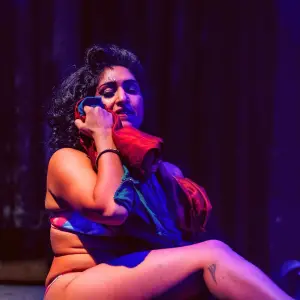 Bolly Ditz Dolly of the Invisible Cabaret.
© Steve Gregson Photography
Bolly Ditz Dolly of the Invisible Cabaret.
© Steve Gregson Photography
Not only did burlesque give each of them a safe space to heal from their trauma or marginalization, but it also helped them—as well as their audience—shatter stereotypes of what’s considered beautiful and challenge preconceptions about what types of bodies deserve to be seen.
“Going to a burlesque show is so different than going to a formal dance show. It’s very interactive … and the audience is so supportive,” Wolf shares. “It’s validating for audience members to see performers who have overcome some serious traumas and challenges in their lives and have found their way to self-acceptance and self-love and how that has empowered them and healed them. It’s uplifting.”
While attending a class for her study of fat burlesque, Yessica Garcia Hernandez, assistant professor of Latina sexualities, popular culture, and performance studies at UCLA, notes that body image is discussed frequently. When one burlesque student shared a story of being called “fat,” it opened up “a conversation about how curves get ranked and how even thin women get traumatized with fat shame. The hauntings of this trauma are heard in the studio, and the conversation about dieting lingers.”
The class helped her confront her own experiences of being fat-shamed, and how her plus size was framed as a personal failure instead of acknowledging the pressures of living in a toxic diet culture that elevates thinness.
“In a field like burlesque, where most professional stages are dominated by thin performers, the mere act of having fat women strip-teasing onstage creates ‘the possibility of a better future,’ particularly for plus-size students who wish to join but are discouraged because of size discrimination,” she writes.
Body diversity
Burlesque can also help women deal with the anxiety and depression many feel over their aging bodies and the invisibility many experience as they age in a culture that celebrates youth and beauty. Middle-aged and older women are often described as asexual, so connecting to a sensual sense of self is important for their well-being, writes Gemma Collard-Stokes, a performance artist and research fellow at the University of Derby who studied nine women aged 50 to 84 who attended recreational burlesque classes.
The women shared that they felt disconnected from their perceived sense of self and their bodies. “The desire to reestablish this lost connection between self and body comes from the need to dispel feelings of an inadequate body.”
Just as important, having a supportive community that validated their sensuality, femininity, and visibility allowed the women to develop healthier body image. As Collard-Stokes writes:
The findings demonstrate that the burlesque class, with its emphasis on establishing sensual connection with the body, [re]establishes the participants’ awareness of the body’s capacity for movement, expression, and fortification, instilling a sense of being happy in one’s skin. Feelings of disconnection are dissipated through the gentle [re]building of the participants’ sense of living within their body rather than with a body. As creative initiatives to support healthy and successful aging continue to expand, this study provides a clear demonstration of how sensual dance movement can be useful for women navigating the less desirable experiences of aging.
Maloof suggests anyone curious attend a show or take a class to see what emotions and sensations it brings up for them. “There are many studies and it’s very true that movement is healing, and dance is healing,” she says. She continues:
The extra element that I emphasize is being witnessed properly—not just our physical bodies, but our personalities and all the aspects of how we show up in the world. We are not seeing the deep and profound beauty that we are. We’re not seeing it, we’re not feeling it, and we’re not allowing it to come through. When you have an opportunity to dip your toe in, and have somebody see you from that place, it allows you to see yourself. I’m biased, but I think it’s the most important work to do.


Comments