Scroll down for a transcription of this episode.
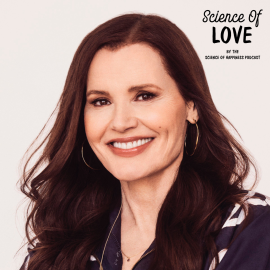
In a culture that often reduces love to romance, Geena Davis helps us explore the science of love across the lifespan—revealing how our bonds with parents, friends, partners, and communities shape our health, happiness, and survival.
Summary: Love is commonly understood as a feeling, yet scientific research increasingly points to its role as a core biological drive. In this episode of The Science of Love, we explore how love is expressed through caregiving, friendship, romantic attachment, and shared experience, and how these connections leave measurable effects on the brain, body, and even the microbiome.
Related The Science of Happiness episodes:
The Science of Love Series: https://bit.ly/TheScienceofLove
36 Questions to Spark Love and Connection: https://tinyurl.com/ktcpz78u
How 7 Days Can Transform Your Relationship: https://tinyurl.com/bdh2ezhr
Related Happiness Breaks:
Take a Break With Our Loving-Kindness Meditation: https://tinyurl.com/2kr4fjz5
A Guided Meditation on Embodied Love: https://tinyurl.com/3dmpfam6
A Meditation on Love and Interconnectedness: https://tinyurl.com/ye6baxv3
Today’s Guests:
ANN DRUYAN is an author, activist, and documentary producer.
Learn more about Ann Druyan’s work here: https://tinyurl.com/5n8crkev
DANIEL LEVITIN is a neuroscientist, musician, and bestselling author of the books, Music as Medicine: How We Can Harness Its Therapeutic Power and I Heard There Was a Secret Chord: Music As Medicine.
Follow Daniel Levitin on IG: https://www.instagram.com/daniellevitinofficial
JESSICA EISE is a social and environmental scientist and is an assistant professor in the Department of Environmental and Occupational Health with Indiana University School of Public Health-Bloomington.
Learn more about Jessica Eise here: https://jessicaeise.com/
ANNA MACHIN is an evolutionary anthropologist who studies the evolution of love.
Learn more about Anna Machin here: https://annamachin.com/
FRANCESCO BEGHINI is a computational biologist at Yale University.
Learn more about Francesco Beghini here: https://tinyurl.com/knm4du4m
ILANA BRITO is a biomedical engineering professor at Cornell University.
Learn more about Ilana Brito here: https://tinyurl.com/mtnhw3yd
CONSTANCE BAINBRIDGE is a Communication PhD student at UCLA.
Learn more about Constance Bainbridge here: http://constancebainbridge.com/
SANDRA LANGESLAG is a cognitive and biological psychologist who studies romantic love.
Learn more about Sandra Langeslag here: https://tinyurl.com/523wc9wx
Message us or leave a comment on Instagram @scienceofhappinesspod. E-mail us at happinesspod@berkeley.edu or use the hashtag #happinesspod.
Help us share The Science of Happiness! Leave us a 5-star review on Apple Podcasts or share this link with someone who might like the show: https://tinyurl.com/2p9h5aap
Funding for this special was provided by the John Templeton Foundation, as part of the Greater Good Science Center's Spreading Love Through the Media initiative.
Transcription:
DACHER KELTNER: Hi, I'm Dacher Keltner. You're listening to a special series from our team at The Science of Happiness, all about The Science of Love, hosted by award winning actress, author and activist Geena Davis. We explore what the research tells us about the many different kinds of love in our lives. Enjoy the show.
[17 seconds] Betty Boop: I wanna be loved by you, just you, nobody else but you. I wanna be loved by you alone, boop boop be doo…
GEENA DAVIS: What is love? For centuries, philosophers, artists and theologians have tried to define it. Scientists are newer to the task. Love is complex, messy and hard to measure, but that hasn't stopped them from trying, and they're beginning to explore just how expansive love can truly be a biological, cultural and social phenomenon. Hi, I'm Geena Davis, and this is The Science of Love by The Science of Happiness podcast and PRX. Over the next three episodes of The Science of Happiness, we'll hear emerging science on why we love, how it develops and how it sustains us across many kinds of relationships, beyond romance, into our friendships, our families and even our non human companions.
The Science of Love after this break.
Welcome to The Science of Love, a special by The Science of Happiness Podcast. I'm Geena Davis, love isn't simply a feeling. Research suggests it's a core biological drive essential for both our happiness and our survival, and we know that it shows up in countless ways, like with the love that shapes us from the start.
ANNA MACHIN: The love between a parent and a child is very, very ancient.
GEENA DAVIS: And romantic love.
SANDRA LANGESLAG: I get shaky knees when I'm with this person. I'm scared to say the wrong thing.
GEENA DAVIS: Our friendships.
MARISA FRANCO: One study found that when people thought friendship was something that happened without effort, they were lonelier five years later.
GEENA DAVIS: The deep connection we can feel towards animals and nature and the love we feel for our wider communities.
SHIRA GABRIEL: It's that connection and that feeling and that love of humanity generally, which leads us to want to help people who are different from us.
GEENA DAVIS: Over the next three weeks, we'll be traveling across the country from Los Angeles to Bloomington, Indiana to St Louis, Missouri to New York City, to find out how scientists are beginning to uncover answers to age-old questions about love. We begin in outer space.
Can you hear that? The heartbeat. That's the heartbeat of a woman in love. Recorded in 1977, it's part of a collection of sounds and images on a record that NASA affixed on their Voyager space probes. The hope was that if any extraterrestrials came across it, they might be able to decode the message and understand at least a little bit about what life is like on Earth.
ANN DRUYAN: It tells the story of our planet through sounds consisting of the world's music, [music plays] images of life on Earth, greetings in some 59 human languages, Planet Earth, the greetings of the humpback whales and crickets and more [animal noises].
GEENA DAVIS: These interstellar messages also included recordings of human biorhythms like brain waves, the sound of laughter and a heartbeat, specifically Ann Druyan's heartbeat.
ANN DRUYAN: It was my great honor to be the creative director of the Voyager interstellar message project.
GEENA DAVIS: Druyan worked on the project with someone whose name you might recognize.
CARL SAGAN: The cosmos is full beyond measure, of elegant truths, of exquisite interrelationships.
GEENA DAVIS: Astronomer Carl Sagan. And over the course of the project, she and Sagan fell deeply in love.
ANN DRUYAN: During the making of the record, when we spoke on the phone long distance, and Carl told me how he felt, and I told him how I felt, that felt like a eureka moment, like Carl and I had made a scientific discovery, and with every heartbeat since, I have to say, it was true.
GEENA DAVIS: When it came time to assemble the Golden Record, Druyan suggested recording a sample of human biorhythms while she meditated on the history of Earth, the history of humanity and the current. Predicaments that civilization was finding itself in. Towards the end, her meditation morphed into a personal one, a meditation on love.
ANN DRUYAN: It began with the love that we feel for our children and our children for their parents and grandparents and guardians and all the different kinds of love that adults feel. And then, you know, Carl Sagan and I had just fallen madly in love, so I had to confide in the extraterrestrials that I had discovered what that feeling was in its greatest meaning, and doubt
GEENA DAVIS: That recording of Druyan's heartbeat during her 1977 love meditation is still traveling through interstellar space, some 15 billion miles away from Earth.
ANN DRUYAN: It feels amazing. It comforts me. I think about it all the time. For me, love and science are deeply inextricably related. You know, because people think that the dispassion that science requires in the gathering of data and its analysis is the same as being unmoved by it, but demystifying love does not make it less. The more you know about it, the greater it is.
GEENA DAVIS: Love is etched onto the most distant human made objects in our universe, and it's embedded in our lives everywhere on Earth. But why do we love?
SARA ALGOE: We love for survival. From the moment we're born through the rest of our lives, we need other people.
GEENA DAVIS: Social Psychologist Sarah Algoe.
SARA ALGOE: For growth, for learning and for thriving.
DANIEL LEVITIN: Love is intangible.
GEENA DAVIS: Neuroscientist Daniel Levitin.
DANIEL LEVITIN: It's not logical. It's not limited to things that we can describe in a three or four dimensional universe.
JESSICA EISE: I suppose I could give you an evolutionary theory as to why we love, which is for group cohesion, because that improves our chances of survival.
GEENA DAVIS: Social and environmental scientist Jessica Eise.
JESSICA EISE: But that feels so flat in the face of how majestic love is.
ANNA MACHIN: In a way, it's a form of biological bribery.
GEENA DAVIS: Evolutionary anthropologist Anna Machin.
ANNA MACHIN: Love evolved to make sure the genes carry on down the generations.
GEENA DAVIS: The people we love can shape our health in surprising ways, right down to the microbes in our body. Reporter Mandy Nguyen met a scientist studying how our relationships leave a biological trace.
MANDY NGUYEN: On a chilly winter morning, I met up with my friend Kelso at a diner in Brooklyn, New York. We came for one thing.
KELSO: Fluffy pancakes, silver dollar pancakes. I don't even know what that means, banana or apple?
MANDY NGUYEN: I met Kelso three years ago, and we see each other pretty often. Sometimes we watch movies. Recently, we've been making s'mores in their backyard. We're usually sharing food.
Isn't that so good? But we may also be sharing something else.
KELSO: Yeah, we are swapping some microbes, right?
MANDY NGUYEN: There are trillions of fungi and bacteria and microbes that call our bodies home, and they're vital to our health, especially those in our gut microbiome. They help us digest food, regulate our immune systems, and have even been linked to conditions from diabetes to depression. I mean, especially like eating these pancakes.
KELSO: Or breathing in each other's faces.
MANDY NGUYEN: Yeah, because we're like a foot away, there's like an Express Highway. Diet or genetics account for a lot of what our microbiomes look like. But recently, scientists have been looking at how our relationships might be changing the microbes in us too.
KELSO: How many of those, like stick around? Do we know?
MANDY NGUYEN: Studies show that mothers pass microbes to their infants and spouses who live together tend to have similar gut microbiomes over time, as do friends.
FRANCESCO BEGHINI: We mapped these villages, and we know who is interacting with whom. We know exactly the kind of relationship these individuals have.
MANDY NGUYEN: That's Francesco Beghini. He's a computational biologist at Yale, he recently conducted a study in Honduras to see how people's microbiomes compared to their loved ones and friends. His team collected saliva and stool samples from almost 2000 Hondurans samples that were sent to his lab at Yale, where Beghini and I met.
FRANCESCO BEGHINI: Yeah, so right now we are heading to our wet lab.
MANDY NGUYEN: The samples are in freezers kept at negative 112 Fahrenheit to keep the cells stable long term.
FRANCESCO BEGHINI: We have racks of boxes.
MANDY NGUYEN: To avoid frostbite. Beghini takes out a box of samples wearing a pair of big, bulky mittens. Yeah, thanks for getting that out for me, that was like a whole thing.
FRANCESCO BEGHINI: We can see around 100, 100 different species of bacteria. That's millions and millions of bacterial cells.
MANDY NGUYEN: When Beghini analyzed the data, he saw that the families and couples living together shared the highest amount of microbes, but he also found a strong similarity between friends, much more than that shared between strangers.
FRANCESCO BEGHINI: So we are able to predict the existence of a relationship based on how many bacteria two individuals share with each other.
MANDY NGUYEN: And the more time people spent together, and especially the more meals they shared, the more their microbiomes converged. Two years later, Beghini checked again, friends who'd stayed close had grown even more alike. It wasn't just about living in the same village or having similar diets. It was about the relationship itself.
ILANA BRITO: The fact that friendship and loving relationships can actually affect your microbiome is remarkable.
MANDY NGUYEN: That's Ilana Brito, a biomedical engineering professor at Cornell University and a co author of the study.
ILANA BRITO: I think one of the things that it brings up, which is intriguing is, what is the impact of all of this sharing that you do with your friends and your family?
MANDY NGUYEN: If the microbiome plays such a huge role in our health and we might be able to spread our microbiomes that comes with the risk of spreading pathogens and disease. But most of the microbes exchanged in the study weren't actively making people sick. They were the kinds that live peacefully in our guts, the ones that might be regulating our overall health.
ILANA BRITO: They serve protective effects for our bodies. And so you can imagine that by sharing these organisms, you're providing that protection for the people around you.
MANDY NGUYEN: And the same microbes didn't just swap between friends, but extended to friends of friends, they could see the microbial similarities in entire groups of people.
ILANA BRITO: And so exposure to different people and intimate interactions might be beneficial for all of us.
MANDY NGUYEN: Just by spending time with our friends and loved ones, we change each other.
ILANA BRITO: Being friends with someone for a long time, being married to someone, sharing a household with someone, those things leave their mark on your microbiome and your biology.
MANDY NGUYEN: Back at the cafe in Brooklyn, Kelso and I finish up the rest of our pancakes and talk about what we're going to do next time we see each other.
KELSO: Or we could do another movie, night or a bonfire.
MANDY NGUYEN: At this rate, I wouldn't be surprised if our microbiomes become more and more similar. We already share friends, hobbies and pancakes. What's a few million microbes?
KELSO: Thanks for your microbes, Mandy.
MANDY NGUYEN: You're welcome. You're welcome.
GEENA DAVIS: The first person we share millions of microbes with is our mothers. When we're born, mothers carry cells from their biological children, cells that cross the placenta during pregnancy. Likewise, children carry cells transferred to them in the womb from their mothers and sometimes their maternal grandmothers and older siblings. And of course, we share more than microbes.
ANNA MACHIN: The love between a parent and a child, particularly a mother and a child, is very, very ancient.
GEENA DAVIS: That's evolutionary anthropologist Anna Machin, again, She studies the evolution of love.
ANNA MACHIN: That was probably the first love. We can tell that partly by the fact that a high degree of the activations in maternal love are within the core of the brain and the limbic area of the brain, which is the ancient bit of the brain. And that little set of biological bribery at that point was really to make sure that moms stuck around and looked after what became increasingly a really dependent baby. I mean, human babies are arguably some of the most dependent babies on Earth.
GEENA DAVIS: Before children even understand words, parents find ways to connect with them through touch, rhythm and song. That's in part because when we hear the same music together, our brain waves can synchronize both to the music and to each other. We'll learn about how music can strengthen love after this break.
Welcome back to The Science of Happiness. I'm Geena Davis. Lullabies seem simple, one of the most basic forms of music, yet their effects are more profound than we might think. Research suggests that lullabies speak a universal human language, one with deep evolutionary roots. Shuka Kalantari reports on how lullabies, across cultures, help caregivers bond with their babies.
ALEXIS CARIELLO: [singing] I trust you, you'll know what to do ….
SHUKA KALANTARI: Alexis Cariello wrote this lullaby for her son Nico in the middle of the covid pandemic. She was pregnant at the time and struggling with severe perinatal depression and anxiety.
ALEXIS CARIELLO: The way that it manifested was very much disconnected from my body, yet I felt prisoner to it at the same time.
SHUKA KALANTARI: Cariello's therapist connected her with a group at Carnegie Hall who helped expecting parents compose lullabies for their babies. She would hold her belly and sing to him to feel more connected.
ALEXIS CARIELLO: [singing] To hold and be held. I trust you.
The process allowed me to kind of tap into the love that I was feeling, because up to that point, I had just been feeling anxiety and sort of dread and like wishing time away [Alexis singing].
SHUKA KALANTARI: Researchers found that when women with high risk pregnancies spent just 20 minutes a day listening to lullabies and gently holding their bellies, they felt less anxious and more connected to their babies.
DANIEL LEVITIN: It's universal. All mothers instinctively sing to their infants, and they instinctively sing across cultures, songs that have very similar features.
SHUKA KALANTARI: Daniel Levitin is a neuroscientist and musician.
DANIEL LEVITIN: The mother uses a soft voice, not a loud one. She uses small stepwise motion or occasional leaps, but slow tempo. If there's a leap, it always comes down again. [singing] Rock a bye, baby. I went up. Now, I'm going down, on the tree top when the wind blows, [piano plays] right.
Infants are learning what their mother's voice sounds like, so that in the dark, when they can't see one another, the mother can still soothe the infant.
[“Synchronise" lullaby in Finnish plays]
SHUKA KALANTARI: Researchers at Harvard's Music Lab have collected the sounds of men and women singing lullabies to their babies from all over the world.
[people singing lullabies]
CONSTANCE BAINBRIDGE: So you'll see the cultures range from like the Arctic, sub Arctic region, all the way to Polynesia, Central America.
SHUKA KALANTARI: That's Constance Bainbridge. She co authored a Harvard study looking at how babies respond to lullabies from different cultures and foreign languages. When the babies heard the music, they relaxed, their heart rate slowed, and their brain activity calmed, regardless of the culture or language the lullabies came from.
CONSTANCE BAINBRIDGE: We also found that age didn't matter for the infants, so whether they were two months old or 14 months old, they had similar relaxation effects. And maybe you would think that with more exposure to music, having lived a little bit longer, there might be more of an effect, but the fact that even those really young infants had that similar effect is extra evidence that this might be something innate.
SHUKA KALANTARI: After Carrillo's son was born, she would sing him the lullaby she wrote every single night.
[Alexis and Nico talking and faint singing]
SHUKA KALANTARI: Five years later, she's sitting with Nico on the floor of their Brooklyn apartment, playing with toys. He tells me he adores music, and every night, before bed, there's only one song he wants to hear. His mom is lullaby, even if it's dark, gentle, soothing and made with love.
And sometimes Nico sings along.
NICO: [singing] You can be tender, give and receive and be with love…
SHUKA KALANTARI: I'm Shuka Kalantari, reporting from Brooklyn, New York.
GEENA DAVIS: Our first love may be our parents, but our first crush can introduce us to a whole new world of feelings and sensations, butterflies in the stomach every time you see the person, a racing heart, sweaty palms, these intense, often overwhelming feelings have inspired countless songs that could. Pair romantic love to substance addiction. But is it true? Are we really addicted to our lovers?
SANDRA LANGESLAG: This is a pet peeve that I have. They will provide a hypothesis that sounds very plausible. You are addicted to your beloved, and then if they break up with you, you go through withdrawal. And yes, that all sounds very plausible, but we need to actually get the scientific evidence
GEENA DAVIS: That's psychologist Sandra Langeslag. Reporter Mandy Nguyen visited her lab at University of Missouri, St Louis, to learn more.
MANDY NGUYEN: Inside psychologist Sandra Lageslag's lab, scientists are doing these experiments to see how love and addiction to a substance compare on a few levels, how they affect our attention, our craving, how pleasant we find them, and how alert they make us feel.
SANDRA LANGESLAG: We're testing participants that are both in love and addicted to something so that we can really in a single person, see how the two compare.
MANDY NGUYEN: And the addiction of interest here vaping. Some research suggests that an addiction to a nicotine vape manifests in the brain similar to stronger drugs like cocaine.
JESSICA: Do you vape? Are you in love? Are you in a relationship? And I was like, well, check, check. Okay, tell me more.
MANDY NGUYEN: That's Jessica. She took part in Langeslag’s study and joined us at the lab to demonstrate how the experiment was done.
SANDRA LANGESLAG: So Jessica, want to have a seat here? Let me get my supplies.
MANDY NGUYEN: Jessica sits in front of a computer, and Lange slag brings over a cap for her to put on.
SANDRA LANGESLAG: Slide the cap down.
MANDY NGUYEN: It's an EEG cap. It sort of looks like a swim cap with a lot of tiny holes in it.
SANDRA LANGESLAG: So here I have the electrodes, and I'm going to click them in each of the holes,
MANDY NGUYEN: Our brains generate electrical signals, and the electrodes can pick that up.
SANDRA LANGESLAG: With a millisecond precision. So you can see in real time, stuff that's happening in the brain
MANDY NGUYEN: Once the cap's on, lang islag sets up a slide show on the computer. It cycles through pictures of Jessica's husband, strangers vaping and strangers doing nothing.
SANDRA LANGESLAG: Your task is just to pay attention to the pictures. Okay?
MANDY NGUYEN: When people look at photos of their loved ones or something that reminds them of their addiction, parts of their brain usually snap to attention without them realizing. Langeslag can measure attention by analyzing Jessica's brain signals, seeing what photos she reacts to the quickest and with the most focus.
SANDRA LANGESLAG: There's always a zillion things going on around us, but we can only focus on a few things at a time.
MANDY NGUYEN: Her participants weren't newly in love. Some were married like Jessica or lived with their partners for years, and most of them were past this early infatuation stage. So it wouldn't have been surprising if the measures for love came out weaker than for addiction, but that wasn't the case.
SANDRA LANGESLAG: On everything that we measure, people score higher for their beloved than for the vape. And so across the board, love seems even more intense than vaping addiction.
MANDY NGUYEN: Langeslag says it's too early to say If love is actually an addiction. Her study is just one data point. We need more studies looking at other kinds of drugs and testing different measurements, but acknowledging just how intense love can feel is an important first step. I'm Mandy Nguyen, reporting from St Louis, Missouri.
GEENA DAVIS: Once we fall in love, keeping the spark alive takes some effort.
JOHN GOTTMAN: The idea really is to have these points of connection between people so that they can have a ritual that allows them to connect emotionally so they don't have parallel lives.
GEENA DAVIS: We explore what the scientific literature tells us about how to keep love alive, plus the love we feel for our friends, our families and our four legged companions. Join me, Geena Davis next week for another special episode of The Science of Happiness, all about The Science of Love.
Thank you for exploring these many forms of love with us. This special is dedicated to the loving memory of radio producer Ben Manilla. The Science of Love is a production of The Science of Happiness podcast at UC Berkeley's Greater Good Science Center. Our executive producer and editor is Shuka Kalantari. Our senior producer and Co-editor is Kate Parkinson Morgan. Sound design and production by Jennie Cataldo of Accompany Studios. Our reporters are Truc Nguyen and Mandy Nguyen. Associate producers are Emily Brower and Tarini Kakkar. Fact checked by Dr. Eli Sussman. Funding for this special was provided by the John Templeton Foundation as part of The Greater Good Science Center's Spreading Love Through the Media Initiative. I'm Geena Davis. I hope your day is filled with love.

Comments