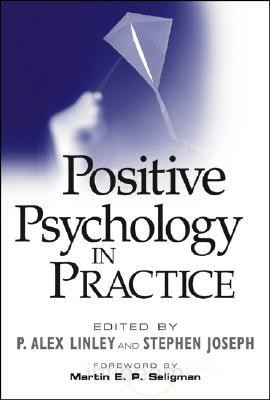
Book Review: Positive Psychology in Practice

By Christine Carter | Fall/Winter 2005-06 | 0 comments

Edited by P. Alex Linley and Stephen Joseph
Wiley, 2004, 770 pages

As editors P. Alex Linley and Stephen Joseph note in their preface, positive psychology—the scientific study of what makes people feel happy and fulfilled—is a burgeoning discipline. At this crucial point in the field’s development, they want their book to be a definitive resource—not just for colleagues in academia, but for practitioners as well.

Over 42 chapters, Positive Psychology in Practice offers plenty of provocative research findings. Psychologist Tim Kasser, for example, makes an important contribution to economics by showing that when people pursue materialistic values—such as wanting to be wealthy and attractive— they report less happiness and lower life-satisfaction. Kennon Sheldon and Sonja Lyubomirsky report that simple practices, such as counting your blessings, may increase your happiness for a sustained time. This finding is significant because previous researchers have long believed a person’s potential for happiness is more or less determined by genetics at birth.
This book distinguishes itself by not only reporting on breakthroughs in positive psychology, but by emphasizing how these findings can be applied. A section dedicated to work includes a provocative chapter on how “transformative leadership”—characterized in part by leaders who do what is ethical, rather than what is expedient or cost-effective—may promote employees’ physical and mental health. Another essay discusses potential applications of positive psychology to youth organizations.
The book is especially relevant to psychotherapists. For example, Chiara Ruini and Giovanni Fava introduce a technique called well-being therapy, which draws on research suggesting that therapists can help patients not only by addressing psychological problems but by teaching them to develop positive characteristics as well, such as self-acceptance and a sense of purpose.

Linely and Joseph have certainly succeeded in creating a comprehensive overview of positive psychology. Though their book is more practically minded than most academic compilations, the volume’s breadth, and sometimes its prose, might put off non-academics. Even so, it is a terrific resource for anyone interested in the important science of positive psychology.

Tracker Pixel for Entry


About The Author

Christine Carter, Ph.D., is the director of the Greater Good Parents program at the Greater Good Science Center, where she writes the Center’s parenting blog, Raising Happiness. She is also the author of the book Raising Happiness: 10 Simple Steps for More Joyful Kids and Happier Parents (Random House, 2010).


Like this article?

Here's what you can do:

Donate


blog comments powered by Disqus
 

Most...

  
  • Why Compassion in Business Makes Sense

    April 15, 2013

    Emma Seppala explains how compassionate workplaces are good for employee health and the corporate bottom line.

  • How to be a Happy Working Dad, Part One

    March 27, 2013

    A new report finds that fitting work with family isn't just a women's issue. Jeremy Adam Smith offers 10 tips for helping fathers to navigate a changing landscape at home and on the job.

  • When Getting Angry Makes You Happy

    April 2, 2013

    A new study shows how seeking happiness at the right time may be more important than seeking happiness all the time.


Greater Good Events

Greater Good Summer Institute for Educators
University of California, Berkeley
Clark Kerr Campus
Friday, June 28 - Wednesday, July 3, 2013


Greater Good Summer Institute for Educators

The GGSC’s six-day Summer Institute will equip educators with social-emotional learning tools that will benefit both students and teachers. Registration is now closed.


» ALL EVENTS


Take a Greater Good Quiz!

How compassionate are you? How generous, grateful, or forgiving? Find out!

» TAKE A QUIZ
 

Dr. Christine Carter's blog on the science of raising happy kids.

» READ MORE
 

Watch Greater Good Videos

Jon Kabat-Zinn

Talks by inspiring speakers like Jon Kabat-Zinn, Dacher Keltner, and Barbara Fredrickson.

Watch
 

Greater Good Resources


» MORE STUDIES
 
 
» MORE ORGS
 

Book of the Week

Why We Cooperate By Michael Tomasello Nature and nurture interact to inform, and reform, cooperative behavior. Infants and apes are both able to share, but only the two-year-old will pick up that thing you dropped in front of her.

» READ MORE
 
Is she flirting with you? Take the quiz and find out.
image

Sponsors

The Quality of Life Foundation logo Special thanks to

The Quality of Life Foundation for its support of the Greater Good Science Center

 
"Greater Good offers a first-rate service to those who want to track new and important research findings in social and emotional intelligence."  
Daniel Goleman

Best-selling author,
Emotional Intelligence and Social Intelligence
(www.danielgoleman.info)