Duncan Stibbard Hawkes
Duncan Stibbard Hawkes, Ph.D., is an assistant professor of anthropology at Baylor University.
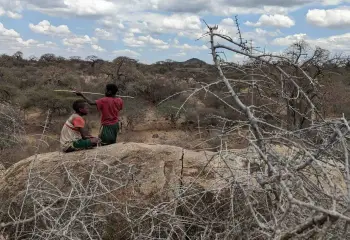
He is an evolutionary anthropologist and conducts field research in Northern Tanzania with the Hadza, a group who traditionally lived by hunting and gathering all their food from nature. Like many hunter-gatherers, the Hadza often generously share food, have relatively little formal leadership, regularly move from place to place, and have little personal property. For these reasons they have been called an “egalitarian society.”
Egalitarian hunter-gatherer societies have been used to help understand what life was like in the deep past before the advent of agriculture; but “egalitarianism” has also been the topic of much mythmaking. His research uses mixed cross-cultural and field research methods to explore the actual motivations, dynamics, and processes underlying Hadza egalitarianism; and the outcomes of these processes on health, status, and nutrition. He explores the ways by which people minimize inequality in both status and property, and the sometimes-self-interested reasons that people generously share food. He aims to foster a clear-eyed, empirical approach to this sometimes highly theoretical topic.
In the last few decades, life for many Hadza has changed due to climate change, within-country migration, tourism, and tighter integration into cash economies. Though most Hadza continue to hunt and gather, most people now augment bush foods with cash-bought grain. Today, some Hadza grow crops and keep animals, and others participate in Tanzania’s tourism industry. Most people move around less than they did in the past. His ongoing research program explores how people are navigating these novel challenges, and the resulting consequences for health-, property-, gender- and status-structured inequalities.
Last, he is interested in the cultural evolution of hunter-gatherer technology. His work has explored what hunter-gatherer material culture can (and cannot) tell us about the deep past. His ongoing research program also explores how technology is adapting and changing in response to new subsistence environments.