Scroll down for a transcription of this episode.
What if getting older doesn’t have to mean losing your memory? Learn how neuroplasticity, healthy habits, and simple memory exercises can help keep your brain strong at any age.
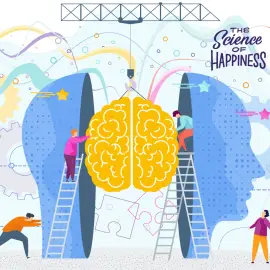
Summary: We often assume that getting older means our memory and brain function will inevitably decline—but emerging science tells a more hopeful story. On this episode of The Science of Happiness, we’ll explore how neuroplasticity, along with practices like memory exercises, stress reduction, sleep, exercise, and finding a sense of purpose, can support brain health as we age.
How to Remember Where You Parked:
- Pause before you walk away: Take a moment to look at your car and notice your surroundings.
- Identify your location: Pay attention to the floor, row, section, level, or nearby landmarks.
- Create a funny image: Turn the location into a memorable mental picture. For example, if you’re parked in section 4B, imagine four bears sitting inside your car.
- Make it vivid: The sillier, stranger, or more ridiculous the image, the better. Let yourself have fun with it.
- Take a mental snapshot: As you walk away, look back at your car and surroundings and imagine the funny scene there.
- Use the image to find your car: When it’s time to leave, bring the funny image back to mind and use it to recall your section, floor, or location.
Today’s Guests:
CRYSTAL LEWIS works with high school students in Washington State, supporting them both in and out of the classroom.
DR. MAJID FOTUHI is a neuroscientist, author, and professor at the Johns Hopkins Mind Brain Institute.
Learn more about Dr. Majid Fotuhi: https://drfotuhi.com/
Related Science of Happiness episodes:
What To Do When Stress Takes Over: https://tinyurl.com/yxf3jawn
Are You Remembering the Good Times: https://tinyurl.com/ysbwrnr4
The Contagious Power of Compassion: https://tinyurl.com/y6bpvbv5
Related Happiness Break episodes:
The Healing Power of Your Own Touch: https://tinyurl.com/rrtpje2x
A Meditation on the Uniqueness of Your Own Voice: https://tinyurl.com/36x3fbk7
The Unexpected Joy of Slow Looking: https://tinyurl.com/4uudwwc2
Message us or leave a comment on Instagram @scienceofhappinesspod. E-mail us at
happinesspod@berkeley.edu or use the hashtag #happinesspod.
Help us share The Science of Happiness! Leave us a 5-star review on Apple Podcasts or share this link with someone who might like the show: https://tinyurl.com/2p9h5aap
Transcription:
SHUKA KALANTARI: Welcome to The Science of Happiness. I'm SHUKA KALANTARI. Today, we're exploring the science of memory and challenging some of the myths about what happens to our brains as we age.
CRYSTAL LEWIS: I just sort of went with the flow of that narrative of, " Yeah, you get older, things start getting a little fuzzier. That's just what happens. You start forgetting stuff."
SHUKA KALANTARI: Recent surveys by the World Alzheimer's Report revealed that about 80% of us think that dementia is a normal part of aging. But it isn't.
CRYSTAL LEWIS: I think my personal complacency with that opinion didn't serve me well.
SHUKA KALANTARI: We'll hear from Crystal Lewis, who's turning 41 soon, a time when some of us might start noticing changes in our memory.
CRYSTAL LEWIS: When I was young, I had a wicked memory, and very detailed, very intricate, and sometimes even, like, photographic. That has since changed.
SHUKA KALANTARI: Crystal recently tried a series of games designed to strengthen memory.
CRYSTAL LEWIS: It almost felt like an assignment in a way. Like, okay, I have an objective, and I want to make sure that I am being as present and observant as possible.
SHUKA KALANTARI: The games were developed by Dr. Majid Fotuhi as part of his approach to supporting brain function.
CRYSTAL LEWIS [ON A RECORDING]: Just because you get older, it doesn't mean your brain will fade, and if you take specific actions, you can indeed maintain your brain function at a reasonable level or improve it, and that's what we did in my brain center.
SHUKA KALANTARI: He'll share practical science-backed ways we can take better care of our brains and keep them strong as we age.
CRYSTAL LEWIS [ON A RECORDING]: Affirmations, positive mindset, growth mindset, having a sense of purpose in life, slow breathing all help to improve the brain biology.
SHUKA KALANTARI: Stay with us.
SHUKA KALANTARI: Welcome back to The Science of Happiness. I'm Shuka Kalantari. This week, we're exploring memory. Emerging science is telling us a hopeful story. Our brains can adapt, and there are things we can do to keep our minds strong and healthy.
Our guest today is Crystal Lewis. She works with high school students in Washington State, supporting them both in and out of the classroom. As she navigates work, family life, and being in her 40s, Crystal has been reflecting on what it means to get older and how we can be more intentional about our brain health.
For our show, she tried several memory exercises from Dr. Majid Fotuhi's 12-week brain fitness program, a set of practices he developed to support cognitive health.
Crystal, thank you so much for being here.
CRYSTAL LEWIS: Thank you so much for having me.
SHUKA KALANTARI: You're balancing a lot in your life every day. You're supporting students at work while also caring for your family at home. Can you paint us a picture of a typical day in your life?
CRYSTAL LEWIS: I work at a high school, so I arrive around 7:30 in the morning, check emails, and then I start going through my appointments that I set with the teenage students that I work with.
Sometimes there are meetings with parents or teachers or administrators. Sometimes I'm doing in-class observations on certain students I've been focusing on. And then the rest of the time I'm straight into parent mode, except for the days where we're not together and she's with her dad. And then I have a little bit of free time, and I like to claim as much of my peace as possible.
Like, it's been a long day, usually pretty fraught with emotion. I work with students who are going through a lot, either academically or in their personal lives and at home. I tend to be pretty extroverted, although this job, I will admit, has brought me a little more inward in my free time. But naturally, I'm a very social person, so I'm buzzing, I'm moving, I'm grooving all the time.
SHUKA KALANTARI: You mentioned that your work has brought you inward, and that makes sense because holding space for your children is a full-time job in itself and then you're holding space for all your children at school. How is that affecting your thought process when you come home from a long day and your clarity of mind?
CRYSTAL LEWIS: Mental health-wise, I'll be honest, it can be really tough because as we all know just because we're capable of carrying heavy loads, it doesn't always mean that we're always in our best form.
When I was young, I had a wicked memory and very detailed, very intricate, and sometimes even photographic. That has since changed.
SHUKA KALANTARI: I want to turn to the practice a bit. I'd love to hear your experience about some of these memory games that you've tried.
CRYSTAL LEWIS: Yeah.
SHUKA KALANTARI: The first game you chose to try is NAME, an acronym for a game for memorizing names. First of all, I'd love for you to walk us through the steps. What does the letters N-A-M-E, name, stand for?
CRYSTAL LEWIS: So, the first letter in the acronym NAME stands for notice. So like when you're first meeting a new person, you try to memorize physical details about them, but just sort of really centering in on them, like almost microscopically and, you know, what do their eyes look like? What does their nose look like? Do they have full eyebrows, full lips? Whatever it is, to just notice as many physical details and audible details as possible.
The next one is “A” for ask, where you're asking their name. You want to hopefully not too awkwardly repeat their name throughout the conversation so that it sort of reinforces that into your mind.
The next letter is “M” for memorize, and you try to memorize while you're speaking with them their name a few times throughout the conversation, just on your own in your mind.
And then the last one is “E” for ensure. You want to make sure that you have their name fully memorized and that you're pronouncing it correctly.
SHUKA KALANTARI: Can you tell us about a time that you tried this name memory practice and how it went?
CRYSTAL LEWIS: Yeah. I actually was recently on a little trip with my daughter, and we were at a fancy resort trying to avoid the Eastern Washington fires and spent a lot of time by the pool, and I met some people there, some families, and I connected with the moms.
And so I noticed, for instance, that this woman, her name was Chelsea, and her eyes were very like cyan blue, so it kind of reminded me of the sea, so I tried to remember like sea, sea, and it also helps 'cause you see out of your eyes.
SHUKA KALANTARI: When you were doing this memory game, did you notice yourself paying more attention to the people you were meeting?
CRYSTAL LEWIS: Yes. It almost felt like an assignment in a way. Like, okay, I have an objective, and I want to make sure that I am being as present and observant as possible. So trying to eliminate the chatter of the kiddos and the splashing of the water and the waiter or whatever it was, and focusing in on them as much as possible because it was something I was trying to be more thoughtful about and commit them to memory in a way that I don't often do unless prompted to.
SHUKA KALANTARI: Let's move on to the second practice, which it's called the memory palace, and it's really fascinating, and I'd love for you to describe this multi-step technique.
CRYSTAL LEWIS: You're supposed to memorize or think about a list of fifteen, twenty, something like that, items. Can be nouns, facts, words, places, whatever it is, names, and then you group them into like three or four.
CRYSTAL LEWIS [ON A RECORDING]: Tether. Map.
CRYSTAL LEWIS: So you have to choose what you wanna remember. [Unintelligible word on recording] And then you choose a familiar place that you know really well. So, I went to my home. Next, you create a clear route.
CRYSTAL LEWIS [ON A RECORDING]: I come in my front door, I walk into my kitchen.
CRYSTAL LEWIS: And you sort of build a path. [LEWIS ON RECORDING: I walk out.] But you do so sequentially, in the same steps so that it's not like, "Oh, I'm coming through the back door now. Oh, no, now I'm coming through the front door."
CRYSTAL LEWIS [ON A RECORDING]: And finally to the bedroom.
CRYSTAL LEWIS: And then the next step, you're supposed to walk through the route in your mind, and with each place that you're navigating through, like in my home, for instance, I would think of the word or the image or the place or whatever it was of the 20 that I thought of before.
And then you're supposed to say the image or the word and notice all the details and sink that into memory as much as possible. Soak it up.
CRYSTAL LEWIS [ON A RECORDING]: Tether. Map. Special. Rain.
SHUKA KALANTARI: Part of the reason why this memory palace practice works so well is that our brains remember images and stories and emotions, and I'm wondering, you know, between those three, which of them was most powerful for you? Or was it an amalgamation of the three that kind of helped boost memory?
CRYSTAL LEWIS: I think that it was an amalgamation of the three. The prompt sort of encourages hyperbole to be more dramatic, emotional, flamboyant, whatever it is, because it will call more attention for you ideally, and you want it to be as memorable and lasting as possible. You can bring sentiment or nostalgia. I'm a very nostalgic person, so that helps me a lot.
SHUKA KALANTARI: After trying these practices, how has your perspective on aging and memory shifted or even expanded?
CRYSTAL LEWIS: Doing these exercises, it's definitely a foreign practice for me. It helped me feel a little bit more like, oh, we do have a say in this a little bit.
Like how I was saying earlier how I just assumed and kinda went with the flow of like, " Yeah, that's just what happens. As you get older, you start forgetting stuff."
The assignment of it all forced me to slow down and be more open and be able to siphon more out of each social interaction that I had with a new person or being more observant about my surroundings, taking it all in to try and commit it to memory instead of it being just like a means to an end.
SHUKA KALANTARI: Crystal, you're almost 41. In the past decade, you became a parent. You're supporting young people in the education system. And given where you are now, what do you hope to carry into the next decade of your life?
CRYSTAL LEWIS: I tend to be an anxious person, and I feel that sometimes I can get overwhelmed and carried away in that, and it makes me much less open and receptive to even simple, silly things that can bring joy or amusement.
When I think of it, the phrase, and it doesn't always apply in this specific way, but you can't take it with you. At the end of your life, are you gonna care about all those little hiccups in the road? Are you gonna care about those really cool moments that you had with your people or with yourself even or a place?
I'm not gonna worry about that traffic jam that I was in, or like the rude waiter, or whatever it is. I'm gonna remember the trip, or I'm gonna remember the drive, or I'm gonna remember whatever, that experience. So I think just to be more appreciative in the things that I choose to focus on and keep.
SHUKA KALANTARI: Crystal Lewis, thank you very much for trying these memory practices for us, and thanks for joining us on The Science of Happiness.
CRYSTAL LEWIS: Thank you so much for having me. This was a good talk. It was yet another reminder to just be more present and like, " You know what? It's all good." So thank you so much for having me.
SHUKA KALANTARI: Up next, we're gonna explore some practical ways to keep our brains healthy and look at what research tells us about memory and aging.
MAJID FOTUHI: Affirmations, positive mindset, growth mindset, having a sense of purpose in life, slow breathing all help to improve the brain biology.
SHUKA KALANTARI: We'll hear from Dr. Majid Fotuhi after this quick break.
Welcome back to The Science of Happiness. I'm Shuka Kalantari. We've been talking about how we're often led to believe that aging automatically means cognitive decline and that memory loss is out of our control, but research challenges that idea.
Joining us is Dr. Majid Fotuhi, a neuroscientist, author, and professor at the John Hopkins Mind/Brain Institute. His work focuses on neuroplasticity, how the brain can change, adapt, and even grow well into older adulthood. He then translates his research into real world tools and tips.
Here's Dacher Keltner's conversation with Dr. Fotuhi.
DACHER KELTNER: Majid, thanks so much for joining us today.
MAJID FOTUHI: It's my pleasure to be on your show. Thanks for inviting me.
DACHER KELTNER: We're really excited to have you. What got you interested in studying the brain and then its role in memory and aging?
MAJID FOTUHI: I fell in love with the brain when I was taking an undergraduate course about physiological psychology.
I just loved how the changes in the brain translate the behavior and how people's behavior is the manifestation of interaction between neurons. What we consider a person is really neurons talking . And the more I studied the brain, the more I loved it.
And what fascinates me the most is neuroplasticity. How is it that our brain maintains its ability to rewire itself at any age? We used to think that only kids can change their brain, but latest research has shown that people in their 60s and 70s, even early 80s.
DACHER KELTNER: Ah, that's wonderful. It's one of the main reasons that we do science, isn't it? Just to challenge misconceptions out in culture.
So speaking of which, many people, and I have to say, including myself, feel or believe that Alzheimer's and dementia and memory loss is just unavoidable, and you've said that isn't true. So, how should we think about these conditions that so many people are affected by?
MAJID FOTUHI: Just because you get older, it doesn't mean your brain will fade, and if you take specific actions, you can indeed maintain your brain function at a reasonable level or improve it, and that's what we did in my brain center.
We had adults in their 70s who came with concern for Alzheimer disease. They had a condition called mild cognitive impairment, and we helped them to memorize a list of 100 words, something they swore to me they couldn't do, that they would never be able to do, and they did it.
DACHER KELTNER: Tell us about memory slips. It's interesting you've observed that everybody forgets things. Often it's adaptive to forget things, but yet somehow as we age, maybe they increase a little bit. We even get more anxious about them. I know I worry today I have a little bit more trouble remembering authors of papers, whereas when I was 35, I remembered it all, and it stirs more anxiety. And you suggest maybe I'm overreacting?
MAJID FOTUHI: You know, there's some wear and tear in our body and in our brain, and the more you do things to protect your brain and protect your body, the fewer of those things you would experience. However, I myself wouldn't dwell on occasional lapses in memory and take for granted thousands of things that my brain does every day.
DACHER KELTNER: Majid, you focus on the hippocampus and the cortex and the role in memory and aging. Tell us about it. What should we know?
MAJID FOTUHI: In 2009, I wrote a paper in Nature about modifiable factors that grow or shrink the size of hippocampus. Hippocampus is roughly the size of your thumb. You have one on the right, one on the left. Hippocampus is one of the most important brain areas for learning and memory. This is where memories are consolidated. It changes so easily, for better or for worse.
It turns out that things like sedentary lifestyle, insomnia, sleep apnea, junk food, stressing too much, not using your brain, they're all associated with a dose-dependent decline in the size of hippocampus. What's fascinating about hippocampus is that it has the highest degree of malleability.
DACHER KELTNER: It's incredible. So I wanna talk about your program, and I literally started to put it into practice when I learned about it. It's a 12-week brain fitness program, and you've tested it scientifically and remarkably.
84% of people who use the program improved in their thinking. And what astonished me is 53% experienced hippocampal growth.
MAJID FOTUHI: I was thrilled that it did. I thought it would take nine months, but in three months it showed significant results, objective improvements in cognitive functions and objective improvements in the size of hippocampus before and after in people in their 70s.
And the program focuses on neuroplasticity. And one of the important things about neuroplasticity is the impact of having a sense of purpose in life, reducing stress. So anything that calms down the cortisol levels is associated with better memory and larger hippocampus size. And so that's one of the reasons that affirmations, positive mindset, growth mindset, having a sense of purpose in life, slow breathing — they all help to improve the brain biology.
DACHER KELTNER: Yeah. So let's just walk through this — so first stop is I should be doing some positive affirmations. We've talked about that science on our podcast, just saying kind words about the self or empowering words. What's one of your favorite positive affirmations?
MAJID FOTUHI: Yeah. When I wake up in the morning, I always appreciate the life that I have because I'm originally from Iran and all the things that are going on in Iran these days, it's so heartbreaking to see people dying, city getting destroyed.
People are suffering. Not only there, people are suffering a lot of places in the world. I feel so blessed to be a professor, be a neurologist, have the life I have here. I'm so grateful for that.
DACHER KELTNER: And the training program that you have for the audience is all these great memory tricks, and they're fun and deal with the everyday memory lapses that are part of life. One of my favorites, and I feel this one or experience this one commonly, is place objects. How do I master the place-objects skill of remembering things?
MAJID FOTUHI: [IN A DIFFERENT ACCENT] "Uh, oh, my phone is here." [KELTNER LAUGHS] I try to make a funny accent, and I pay attention to the phone and where I'm putting it by combining it with something funny.
A lot of learning has to do with making emotional impression. And when it comes to memorizing names, if you learn something about the person, like how many kids they have, where they grow up, what they do, it's a lot easier to remember their name later.
DACHER KELTNER: So, so wonderful, and so nicely linked with humor to the memory literature, which really adds vividness to that. So, how in the world should I remember where I parked?
MAJID FOTUHI: Make a funny image of where you parked it with the floor and where the car is. So it's like 4B, you think of four bears sitting inside your car. So look at your car and see four bears sitting there. It's four bears, 4B.
And it's actually fun. These imagination things are actually fun. They're good for your brain because you're practicing memorizing things, but you make it into a game.
And I tell you, I never, ever forget where I've parked my car. The funnier it is, the easier you'll remember.
DACHER KELTNER: I love the humor that runs through your program.
I'm just curious, you've cited it already, Majid, but meditation's important. What kind of meditations do you do?
MAJID FOTUHI: I actually like slow breathing exercises. These exercises have been shown to improve memory and reduce the load of Alzheimer's footprints in the brain, and you have fewer amyloid plaques in your brain. To me, that's just incredible.
And the way it works is you just sit somewhere quiet, you put your foot down, and you do a breathing exercise where you breathe in for the count of six, you hold for the count of three, and you breathe out for the count of six. It doesn't have to be six, three, six. It has to be just a very slow breathing. And I usually try to pay attention to the movement of air to my nostrils.
DACHER KELTNER: Tell us how you think about exercise and the benefits in terms of hippocampal volume with exercise.
MAJID FOTUHI: Exercise is truly the fountain of youth. It is the single most important factor for brain health. It's a no-brainer. Sometimes people go to a gym and just do some weights and they go home.
You really have to become more fit. You increase your endurance. You have to have stamina. The second thing is sleeping. You need to make sleep a priority. In your
DACHER KELTNER: neuroscientific career, how do you think about the magic of sleep at the neuroscientific level and what it does?
MAJID FOTUHI: Oh, yeah, it's very striking.
One study showed that if you sleep fewer than six hours a night, your hippocampus may be tiny little bit smaller than other people. However, if you have insomnia for five, 10, 15, 20 years, there is a direct dose-response relationship. People who sleep fewer than six hours a night for 20 or 25 years have hippocampus which is almost half the size of hippocampus of those who have normal sleep.
And I really make sleep a priority for myself. I always make sure I have seven to eight hours of sleep, and if I travel or if I do things that interrupt my sleep, I always catch up with a nap.
DACHER KELTNER: It's really striking, and you mentioned this earlier in our conversation about purpose. You know, just having a sense of purpose, sense of meaning, that you're doing things for other people, that you keep things in perspective. So, how do you think about this kind of abstract thing we call purpose and how it's good for brain health?
MAJID FOTUHI: It turns out that people who have a sense of purpose in life are less likely to get Alzheimer's disease by 19%. They're less likely to have heart attacks by 12 to 19 percent. They have fewer strokes by 50%.
One study showed that people with sense of purpose have 50% fewer stroke than people that don't. When you account for comorbidities like high blood pressure, obesity, smoking, when you take account in all of those things, which by the way, people who have a sense of purpose have better lifestyle choices, there's still a 50% reduction in number of strokes.
So I always talk to my patients at the beginning of the program, why do you wanna have a better brain? Why do you wanna be sharper? Why do you wanna live longer? Sometimes people know those things in the back of their mind, but they're not conscious of it, so we help to bring it to the surface because then, that gives them motivation.
If, for example, they say they love their grandchildren, we'll tell them, "Wouldn't you love to be dancing with your granddaughter in her wedding? Won't you wanna be in a good physical shape so that you could be there?"
And sometimes people don't have one. A lot of people pay the mortgage, work hard, do the chores, and they go on a vacation. That's life. That's not how to do it. You really need to define your sense of purpose.
DACHER KELTNER: How should each person listening to this show integrate what you've talked about and develop a really realistic brain health routine?
MAJID FOTUHI: First, you need to establish that there are five pillars of brain health, and they need to be a priority for your day-to-day life: exercise, sleep, healthy nutrition, low stress, and brain training.
And then don't add that as one more source of stress for yourself. Don't stress over things that are minor. You know, we create things like, " It's an emergency, like I'm gonna be late, it's an emergency."
It's not. I think it's really important to realize most things in life are not that deep, really.
DACHER KELTNER: Majid, I wanna thank you for being on our show.
You have done such an inspiring job of giving us actionable knowledge about how to take the science of happiness, add things like sleep and food and exercise, and have a better brain over the course of life. It's been really inspiring for me. Thanks for being here.
MAJID FOTUHI: It's been a pleasure talking to you, Dacher.
SHUKA KALANTARI: What if one of your most powerful senses is one you barely notice?
SAMIN NOSRAT: It really started with Aristotle dissing olfaction as an animalistic, primitive sense. But we're finding human memory consolidation is affected by nasal respiration, that nasal respiration is a master synchronizer of brain function.
SHUKA KALANTARI: We learn why smell has such a direct line to memory and emotion. That's next time on The Science of Happiness.
Our associate producers are Emily Brower and Anna Zou. Our producer is Truc Nguyen. Our sound designer is Jennie Cataldo of Accompany Studios. Our host is Dacher Keltner. I'm the executive producer, Shuka Kalantari.
Thanks for listening to The Science of Happiness.






Comments