Though Djurdja Padejski was raised in communist Yugoslavia, her life there felt stable and uneventful for a long time. In the 1980s, under Yugoslavia’s “soft” one-party government, Padejski and her friends read Western literature, watched Hollywood movies, and listened to the BBC.
 Protestors against President Donald Trump through Los Angeles in 2016.
“We grew up in a very comfortable, naive environment,” Padejski says.
That changed in the 1990s when Yugoslavia split into several republics. Civil war broke out, and a virulent strain of nationalism took hold in Serbia, the Yugoslavian state where Padejski lived. Firebrand leader Slobodan Milošević ascended to power and began meddling in elections, targeting opposition leaders, and igniting ethnic cleansing campaigns.
“He captured the entire society and his party,” Padejski remembers. “Very soon I found myself on the streets protesting.” Padejski’s activism against repressive Serbian regimes would continue until 2011, when she and her husband, investigative journalist Djordje Padejski, left the country after people threatened to kill them.
The Padejskis arrived in the U.S. with hard-won knowledge of how to outlast repression over the long haul. In recent years, they’ve tapped back into that knowledge and shared it with those around them as they witness here in America the illegal destruction of government agencies, election tampering, and warrantless arrests of citizens and non-citizens. This isn’t just true in the United States—around the world, democracy is declining.
How can we go on defying rising authoritarianism when no clear endpoint is in sight? Psychology and motivation research complement the experience of people like the Padejskis by addressing how to conserve energy and sustain commitment to your ideals in challenging conditions.
“The goal of the authoritarian regime is to desensitize us to extremes, to things we should never agree with or consider normal,” says Djurdja Padejski, now a language and culture researcher (and doctoral candidate) at Arizona State University.
Surviving repression depends on rejecting this presumed “normality” and refusing to let your inner state mirror extremes imposed from above. To that end, here are seven research-backed ways to subsist under indefinite duress.
1. Acknowledge your own limits as a prelude to targeted action
Life under repression feels exhausting due to the colossal scale of so much of what is happening: attacks on the free press, denial of life-saving aid to millions overseas, ongoing ICE killings on the streets and in detention facilities. Reading about such developments understandably triggers feelings of overwhelm. Research finds that these feelings can drive people to shut down their emotions, dampening their motivation to help in concrete ways.
Djurdja Padejski has come to recognize that to avoid that trap, she has to face her human limits squarely without drowning in self-recrimination. As a young adult under Milošević’s rule, she learned early that worrying about what she couldn’t do was a waste of time and energy.
“It is very important not to get stuck in that moment, not to be clutching your pearls,” she says. “We have to be strategic to preserve our resources.”
Admitting your own lack of control over the big picture can be a necessary prelude to taking the actions still available to you, Padejski says. “We have to see [the situation] for what it is, so we can focus our efforts on keeping our minds, our bodies, and our communities as healthy as possible under the circumstances.”
2. Embrace daily, low-key “micro-resistance”
Once you’ve gotten clear about what is within your power to control, you can get granular by carrying out regular acts of “micro-resistance.” These acts of defiance do not require you to upend your daily rhythms or put your life on the line. They can be as simple as attending a march, supporting a neighbor at an immigration court visit, or wearing a shirt with a resistance slogan.
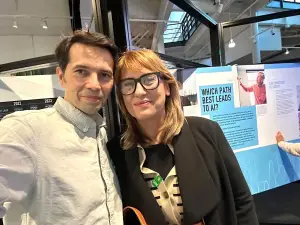 Djurdja and Djordje Padejski.
Micro-resistance acts—such as creating protest art and continuing to study even when their department was banned from the university—helped sustain both Padejskis through years of repression, reminding them of the power they had despite limits imposed from on high.
“These micro-level actions add up,” Djordje Padejski writes. “Even small acts of defiance can maintain your sense of agency.”
Self-described “small-time” lawyer Daniel Suitor excels at this kind of micro-resistance. During ICE raids in his hometown of Minneapolis, he channeled his overwhelm by signing up for a course on how to file legal paperwork to free unjustly detained Twin Cities residents.
After Suitor filed his first case, he found out surprisingly quickly that he’d won and that the man he was representing would be freed. That proof-of-concept case spurred him to file another legal petition, then several more in quick succession. And he wasn’t alone in his commitment: To date, Minnesota lawyers have filed more than 1,000 cases challenging unjust detentions.
Acts of micro-resistance can also help prime us for future courageous action. When people perform smaller acts of selflessness and service, large-scale heroism becomes easier to contemplate, explains Medical College of Wisconsin heroism researcher Zeno Franco. Concrete practice can make you more adept at translating abstract ideals into action.
“You need to understand beyond theory,” Djurdja Padejski says. “We actually, as humans, can’t imagine how concepts work in [the] real world unless we experience them hands-on.”
3. When no clear end to repression exists, set self-determined checkpoints
For the Padejskis, one of the most stifling aspects of life under Serbian autocracy was not knowing when the repression would lift, if at all.
Periods of confinement, literal or figurative, are more bearable when a clear endpoint is in sight, and indefinite periods of repression feel uniquely oppressive. A third or more of incarcerated people with open-ended sentences suffer from depression. Others feel rooted to the present moment, severed from any potential future.
“I simply try to live in the here and now and not to plan,” one prisoner told the University of Bern researcher Irene Marti, who studies open-ended confinement. “Because I don’t have any future or only one that is very far away.”
“We have to be strategic to preserve our resources”
When the endpoint of repression is uncertain, or when a challenging situation has no clear natural limit, creating your own intermediate endpoints can help you stay committed to your goals and values.
In a recent goal-setting study, when people broke an annual community service goal into granular sub-goals (say, four hours of service a week, or eight every two weeks), they volunteered more hours in the long run than people without intermediate goals.
In the same way, committed resisters can pledge to put in a set number of hours each week, or carry out a set number of clearly defined actions. According to self-determination theory, choosing and pursuing your own accessible goals boosts your well-being and motivation—internal changes that persist even when the larger crisis remains ongoing.
4. Observe the bending of the broader arc
As governments around the world curtail freedom of speech and movement, it’s hard not to feel the noose tightening. One way to create more existential breathing room is to consider how this moment fits into the longer arc of history.
This helps you subsist in the present by reminding you of parallel past moments (whether decades or centuries ago), how they came to a head, and what ultimately resolved them. Research finds that when people take a long-term perspective, reflecting on recent stressful events as though they happened far in the past, they report less emotional distress in the moment.
Djurdja Padejski found solace in doing this during Milošević’s reign. “I survived that period mostly by reading the columns in the newspapers,” she says. One column in particular, by Serbian anthropologist Ivan Čolović, examined the regime’s activities from a broader historical and social perspective.
“He was offering a vocabulary and a theoretical apparatus to help us deal with the horrors of civil war. The news about it was the most severely censored, the propaganda was relentless, and all of it was new for many of us who were children when the fallout of our world began,” Padejski says. “That’s how I survived with my sanity intact, because it helped me to recognize what is happening to society.”
5. Break out of the extremist online box
Among the most potent present-day energy drains is the social media industrial complex that feeds on people’s rage and frustration, serving up extreme viewpoints that deepen entrenched social divides as they rack up likes and views.
“Social media and internet platforms—they’re amplifying what is also a typical quality of authoritarian regimes. They’re all about grandiosity,” says Djurdja Padejski, who studies the linguistic mechanisms of propaganda. “Algorithms grab people’s attention by intensifying the language and the visuals and the overall framing.” That’s a big reason why frequent social media use saps your cognitive resources and motivation, making it harder to subsist under repression.
“Even small acts of defiance can maintain your sense of agency”
Plugging this energy drain requires not just limiting your time online, but redirecting more of that time to the in-person, small-group exchange to which humans are uniquely suited.
When you engage with people face to face, it’s much harder to reduce them to a stereotype or particular viewpoint. And by getting to know them in all their messiness, contradiction, and complexity, you bond with them in ways that lighten the mental and practical load for everyone involved.
“To resist this reduction of our existence to, ‘What are you for or against?’ means embracing creativity, art, friends, communal projects, protests, walks,” Padejski says. “These 10 years of resistance [in Serbia]—I honestly remember it as a series of walks. Sometimes that meant running away together from Milošević‘s militias or the official police, or from water cannons, or rubber bullets. But what is left is our conversations on ideas, on creations.”
Though exchanges like these may not further resistance directly, they form the edifice that sustains it. Within bonded human-scale communities, members have a clear sense of not just their own energetic capacity, but that of others in the group. That means they can pinch-hit for one another: When someone needs help, they can fill in on the spot—or, like relay racers, take up the baton when someone needs to withdraw. This shared flexibility and responsiveness help all group members to stay committed for the long haul.
6. Safeguard your true sources of value at all costs
For the Padejskis, subsisting under Serbian repression meant homing in on the values that were most important to them, and upholding those values even if it meant sacrificing convenience or comfort. When Djordje Padejski needed a lifesaving drug, a relative told him he could work his connections to obtain the medicine, but only if Padejski joined the Serbian dictator’s political party. Padejski refused, knowing that doing so put his health at risk.
The couple have continued that tradition in the U.S., though in somewhat less life-altering ways. After Elon Musk unleashed an apparent Nazi salute at a Trump post-inauguration event, the Padejskis gave up their Tesla. “I drive a Subaru now,” Djurdja Padejski says. “I really don’t like it compared to Tesla, but I don’t regret it.”
“Biding your time is not the same as surrender”
Some people write off such moral stands as more symbolic than substantive. But symbol, it turns out, shapes substance: What you stand for predicts and influences what you’ll do down the road, for good or ill. When people have a clear, consistent moral identity, studies find, they’re more likely to take real-world action aligned with that identity.
On the other hand, when you’re willing to cave on something that seems minor, like supporting a complicit business, “you are detached from your inner beliefs, from what you know is real and good and safe,” Djurdja Padejski says. “Once you’re there, you are ready to compromise a lot of values that you think you are really one with.”
7. Keep your powder dry until the right moment
One unexpected thing the Padejskis learned, under Milošević and afterward, was the importance of not swinging into action every time a devastating piece of news hit. Overcommitment amounted to self-sabotage, sapping energy and resources they’d need later on.
Military commanders have long known the importance of “keeping their powder dry,” Zeno Franco points out, holding back so they can act at the moment of maximum impact. In the same way, the best long-distance runners often hang back throughout a course to conserve energy, then uncork a burst of speed in the race’s final minutes.
Djurdja Padejski followed this principle to great effect under Milošević. She bided her time leading up to the critical elections of 2000, then worked tirelessly as an election volunteer to monitor for irregularities and make sure no one was falsifying results. All the while, ruling party members with guns lurked in the background.
“This guy started opening his gun and checking the bullets, and we didn’t cave. We just ignored him,” Padejski says. “We knew we were risking our lives, but we really believed it’s now or never.” Serbia’s democratic opposition party ultimately won that election, causing Milošević’s downfall.
Padejski hopes democratic activists around the world will take a similar approach as crucial elections near. Under repressive conditions, keeping your powder dry “is not an instruction to put off action as long as possible, but rather the wisdom to know that being prepared to act at just the right moment may require careful guarding of resources and energy,” Franco says. “Biding your time is not the same as surrender.”


Comments