When Roger Clemens was indicted on Thursday for lying to Congress about whether he’d used performance-enhancing drugs, it’s unlikely that many Greater Good readers were surprised.
Shortly after Clemens testified before Congress in February of 2008, Greater Good Executive Editor Dacher Keltner analyzed Clemens’ facial expressions in our Body Language column. Drawing on his expertise in decoding the emotional messages conveyed by subtle facial expressions, Dacher found reason to believe that Clemens wasn’t telling the truth. It seems like the federal grand jury agreed.
Here’s what Dacher originally had to say about Clemens’ performance on Capital Hill, based on the photo below:
 © Pablo Martinez Monsivais/Associated Press
Research has identified seven strong clues that someone is lying: speech hesitations, stammering or repeating their words, sudden rises in the pitch of their voice, subtle facial expressions of negative emotion, touching their face, jiggling their legs, or nervously biting or licking their lips.
Roger Clemens is clearly showing two of them here. Of course we can’t hear his speech patterns or the pitch of his voice. But we can see a nervous lip movement, with him wetting his lips—a classic sign of anxiety. Second, if you look closely, you can detect a micro-expression of negative emotion, where the left corner of his lip is moving slightly down and to the side, and there’s a bit of pouching in his lower left cheek. These movements generally signal emotions of sadness, distress, or anxiety.
When people display these kinds of quick, subtle expressions, it’s as if they’re betraying their true feelings toward what they’re saying. Clemens wants to project that he’s telling the truth, but in these quarter-second displays of emotion, he’s suggesting that he’s really saddened, anxious, distressed, or even disgusted by what he’s telling Congress. That suggests he’s lying.
By contrast, here’s what Dacher made of Clemens’ former teammate Andy Pettitte when Pettitte apologized at a news conference for using human growth hormone:
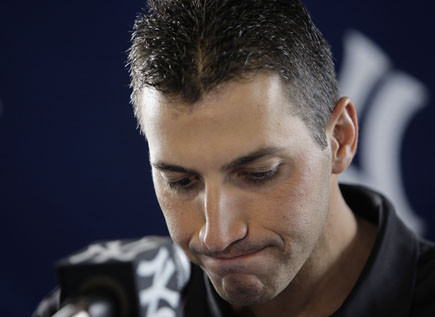 © Julie Jacobson/Associated Press
To most viewers, Pettitte’s expression will seem more genuine and trustworthy than Clemens’. How does he give that impression?
For starters, he’s offering a universal display of contrition. Pettitte is dropping his head down, and he’s averting his gaze from making eye contact with anyone. In the muscle movements around his mouth, we can also see displays of shame and embarrassment: The mentalis muscle is moving his chin up and tightening his lip corners, and as a result, a crest is forming around the corners of his lips.
There are evolutionary theories for why these kinds of gestures would be associated with apology, shame, and embarrassment. One theory is that downward head movements shrink the body’s posture, and that’s a sign of submissiveness across primate species. Avoiding eye contact with someone else is another sign of submission. And the tightening of muscles around his mouth could signal that he’s constraining emotion.
Taken together, these movements give him a more modest, deferential, non-threatening appearance—the kind of appearance you’d want to present when you’re asking for mercy or forgiveness.






Comments
Pettitte is dropping his head down, and he’s averting his gaze from making eye contact with anyone. A master of acting
table display | 10:03 pm, October 7, 2010 | Link
You’re just great when writing this issue. Love it so
much. Makes me want to meet you someday to
discuss regarding this issue. Love it ! How can i
contact you.. Thanks in advance.
Car Dolly | 8:24 pm, January 9, 2012 | Link
I really needed to buy a car for my firm but I did not earn enough money and couldn’t purchase something.
Online Business Directory | 11:27 pm, January 13, 2012 | Link
Thanks to author for appreciated post, I was looking for this post since for a while, Glad to found this post, I’ve bookmarked this post to keep update
Directory Listings | 11:30 pm, January 13, 2012 | Link
Thanks for sharing these reference videos. Have to make time to watch all of it but these should be a useful bunch coming from you
mypaydayloansonline.co.uk | 5:11 am, January 21, 2012 | Link
Its really very best and useful site for all,I am using it from a long time,I really got many information from this site.I would like to thank you for the efforts you have made in writing this article. I am hoping the same best work from you in the future as well
read more | 9:34 am, January 21, 2012 | Link