Pleasure Principles

By Pelin Kesebir | September 20, 2010 | 0 comments

A review of How Pleasure Works: The New Science of Why We Like What We Like

How Pleasure Works: The New Science of Why We Like What We Like is an engaging, stimulating, and richly informative book on “why we like what we like.” Paul Bloom, a professor of psychology at Yale University, explores a broad range of human pleasures from food to sex to religion to music. Drawing on diverse fields of knowledge, including evolutionary theory, developmental psychology, philosophy and neuroscience, Bloom convincingly drives home the message that human pleasure is not purely an instinctive, superficial, sensory reaction; it has a hidden depth and complexity.

It is thus not true, in Bloom’s view, that we derive pleasure from food simply because of how it tastes, from music simply because of how it sounds, from art simply because of how it looks. Rather, our enjoyment of these things is affected by considerations that go beyond what our senses perceive, encompassing the object’s origin, history—in short, its essence.
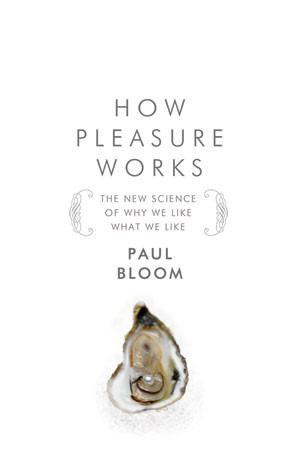
W. W. Norton & Co., 2010, 280 pages W. W. Norton & Co., 2010, 280 pages

Humans’ “essentialist” mindset shapes our understanding of the physical and social world, and determines what we find pleasurable, as well as disagreeable. When people are willing to pay thousands of dollars for a tape measure owned by John F. Kennedy, for example, this reflects a desire to own an object that seems to contain JFK’s essence by dint of having been touched by him. Conversely, when people refuse to eat fudge shaped like feces, sip fresh water from a cup labeled cyanide, or wear a sweater that supposedly belonged to Hitler, their essentialist minds are again at work.
In accessible, lucid prose, Bloom delves into the various sources of human pleasure with dazzling intellectual depth and breadth. His discussion of the uniquely human pleasures of imagination—fiction, movies, television, daydreaming—is particularly thoughtful and thought-provoking. These pleasures serve as proxies, argues Bloom, for other pleasures that are inaccessible, too risky, or too much work. His argument is convincing: After reading it, you may never watch a movie the same way again.

Ultimately, Bloom distinguishes himself not just as a great thinker but as a great writer, successfully weaving together fascinating findings from psychology experiments, memorable quotes, and illuminating anecdotes. Deploying his skills as a storyteller as well as a psychologist, he makes clear why experiencing—and understanding—pleasure is key to a meaningful life.

Tracker Pixel for Entry


About The Author

Pelin Kesebir, Ph.D., is a social psychologist who is currently a post-doctoral research associate at the University of Colorado, Colorado Springs. Her research explores different aspects of existential human motivation and their implications for individual and societal well-being.


Like this article?

Here's what you can do:

Donate


blog comments powered by Disqus
 

Most...

  
  • Why Compassion in Business Makes Sense

    April 15, 2013

    Emma Seppala explains how compassionate workplaces are good for employee health and the corporate bottom line.

  • How to be a Happy Working Dad, Part One

    March 27, 2013

    A new report finds that fitting work with family isn't just a women's issue. Jeremy Adam Smith offers 10 tips for helping fathers to navigate a changing landscape at home and on the job.

  • When Getting Angry Makes You Happy

    April 2, 2013

    A new study shows how seeking happiness at the right time may be more important than seeking happiness all the time.


Greater Good Events

Greater Good Summer Institute for Educators
University of California, Berkeley
Clark Kerr Campus
Friday, June 28 - Wednesday, July 3, 2013


Greater Good Summer Institute for Educators

The GGSC’s six-day Summer Institute will equip educators with social-emotional learning tools that will benefit both students and teachers. Registration is now closed.


» ALL EVENTS


Take a Greater Good Quiz!

How compassionate are you? How generous, grateful, or forgiving? Find out!

» TAKE A QUIZ
 

Dr. Christine Carter's blog on the science of raising happy kids.

» READ MORE
 

Watch Greater Good Videos

Jon Kabat-Zinn

Talks by inspiring speakers like Jon Kabat-Zinn, Dacher Keltner, and Barbara Fredrickson.

Watch
 

Greater Good Resources


» MORE STUDIES
 
 
» MORE ORGS
 

Book of the Week

Why We Cooperate By Michael Tomasello Nature and nurture interact to inform, and reform, cooperative behavior. Infants and apes are both able to share, but only the two-year-old will pick up that thing you dropped in front of her.

» READ MORE
 
Is she flirting with you? Take the quiz and find out.
image

Sponsors

The Quality of Life Foundation logo Special thanks to

The Quality of Life Foundation for its support of the Greater Good Science Center

 
"Greater Good offers a first-rate service to those who want to track new and important research findings in social and emotional intelligence."  
Daniel Goleman

Best-selling author,
Emotional Intelligence and Social Intelligence
(www.danielgoleman.info)