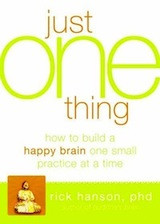
In his previous best-selling book, Buddha’s Brain, Rick Hanson detailed the research that shows how our thoughts, feelings, and actions shape the neural pathways of our brains, in both positive and negative ways. Hanson, a neuropsychologist and founder of the Wellspring Institute for Neuroscience and Contemplative Wisdom, set the groundwork for a neurological understanding of the benefits of contemplative practice.
In Just One Thing, he applies that understanding to daily life and provides 52 research-grounded practices that anyone can do to become happier, healthier, and more peaceful. Examples include getting more sleep, savoring life’s pleasures, seeking beauty in everyday experiences, relaxing around imperfection, and showing gratitude. For each practice, Hanson gives a short explanation of the practice and its benefits, followed by a more detailed description of how to approach it.
Of course, you don’t have to do all 52 practices to reap the benefits. Some will appeal more than others, and Hanson encourages readers to choose the ones that work best for them. “How you use your mind changes your brain—for better or worse,” writes Hanson. “You can’t stop your brain from changing.” So, why not try these practices a little bit each day and direct your brain toward the positive? No doubt, if you take Hanson’s advice, you will be doing yourself—and your brain—a big favor.







Comments
I enjoy Hanson’s articles. They are imbued with tremendous sensitivity and practicality. Yet I am continually frustrated by his failure to take the next step. Yes, our thoughts do change our brains. But they do even more than that - they actually impinge upon our physical reality, in a creative process of incredible subtlety that is easily missed. Recognition of this fact takes mindfulness to the ultimate level, but it is a place that Buddhist practitioners do not want to go. Hanson has no doubt learned a lot from Buddhism, but it is time for him to move on.
Higher Plane | 7:23 pm, December 4, 2011 | Link