Last month, we invited you to take a quiz measuring your level of trust, zeroing in on a close (most likely romantic) relationship of yours. The quiz, based on work by researchers at the University of Waterloo in Canada, measures how dependable, honest, and reliable you believe your partner to be, how responsive you think they will be when you need them the most, and how much faith you have in your relationship as a whole.
 © Brad Aldridge
So far, roughly 1,700 Greater Good readers have completed the quiz, and apparently, you’re a pretty trusting group. Your median score puts you right smack in the middle of the “high” range of trust, according to the original data collected by the Canadian research team.
When we analyzed the results more closely, here’s what we found:
• There was no correlation between trust and age—people didn’t get any more trusting of their partner as they got older, nor did younger people trust more.
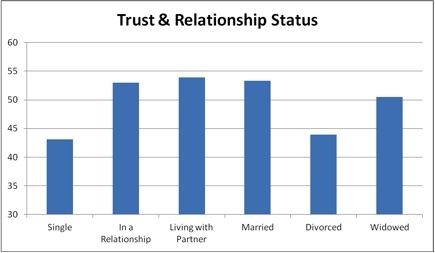
• Relationship status was strongly tied to trust level: People who were in a relationship (living with their partner or not) or married were the most trusting, while divorced people and single people were the least trusting (see graph below).
• Their parents’ marital status did not affect how trusting participants said they were.
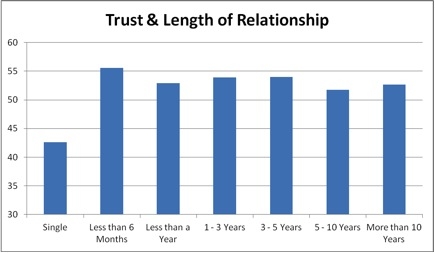
• The length of a relationship was related to one’s level of trust—but the people who were most trusting were those who had been in their relationship for the least amount of time, six months or less (see graph below).
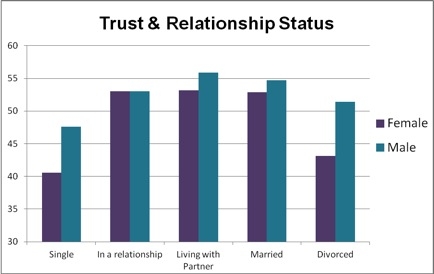
• Men in general had a slightly higher trust score than women.
• This gender difference appears most strongly among single and divorced people: Divorced (and single) women were significantly less trusting than their male counterparts. In general, men’s trust was much more stable regardless of their relationship status than women’s (see graph below).
We want to hear what you make of these findings. Weigh in with a comment below.
Also please take our new quiz on gratitude, just in time for Thanksgiving. And if you still haven’t taken our quick trust quiz, click here to get started.






Comments
Fascinating! I have to wonder if the lower trust found with single people has to do with reality. Retailers insist that shoplifters are generally by themselves, and I find that I get more respect when I’m with my boyfriend or with other people. Anything from walking down the street (groups of people hog the sidewalk) to signing up with a new insurance company. Single people get treated like doormats.
Emmy | 12:04 pm, November 21, 2011 | Link
Clarification: that includes single *status*, i.e. even when I’m not with my boyfriend, people seem to respect me more when they hear I’m in a relationship vs when I was alone.
Emmy | 12:06 pm, November 21, 2011 | Link
I agree you do get validation for being in a
relationship. I don’t know whether shop keepers
truly believe that single people are more likely to
be immoral and thieves or whether shoplifters tend
to work alone.
This article did not make a explicit statement
about whether being more trusting is good or bad.
It seems the implicit assumption (or what I assumed
at first) is that being more trusting is good.
Men are more trusting than women ? Women have
to deal with a bit more sexism/sexual harassment
than men in general. I am a woman and I was
brought up to be less trusting, “don’t go into a
house alone with a man, don’t walk in dark alleys,
look out for strange people, be careful of how you
dress” in order to stay safe.
If this study found that white people were more
trusting than black people, it would make sense to
me given that black people have to deal with
racism’s lingering effects.
I also think that it would be interesting if they did
this experiment with preschoolers vs teenagers to
see who is more trusting.
Marisa | 7:58 pm, December 27, 2011 | Link