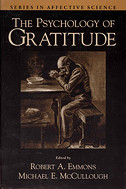
Book Review: The Psychology of Gratitude

By Christine Carter | Fall 2004 | 1 comment

Edited by Robert A. Emmons and Michael E. McCullough
Oxford University Press, 2004, 368 pages

The title of The Psychology of Gratitude sells the book short. In this compilation of 14 essays, editors Robert Emmons and Michael McCullough go beyond the field of psychology to incorporate research from anthropology, philosophy, biology, theology, and even primatology. This breadth of research gives a deservedly thorough treatment to a human emotion and virtue that, until now, social science has largely overlooked.

The volume both defines and explores the contours of gratitude. Theologian David Steindl-Rast distinguishes gratefulness from thankfulness. Thankfulness, he says, is marked by personal gratitude for undeserved kindness “because it typically expresses itself in thanks given to the giver by the receiver of the gift.” Gratefulness, on the other hand, is transpersonal: its experience goes beyond an emotion directed toward any one person to encompass an “oceanic feeling of universal belonging,” such as when someone feels grateful for a beautiful sunrise.
Other authors consider the beneficial consequences of gratitude. Psychologist Philip Watkins shows that gratitude is part of a cycle of virtue: Gratitude causes happiness, while at the same time, that feeling of happiness fosters gratitude. Barbara Fredrickson draws on previous research to theorize that gratitude broadens a person’s capacity to express love and kindness, which helps that person build lasting friendships and other social bonds. If someone feels grateful toward another person, she suggests, he’ll try to promote the well-being of other people in general, not just of his original benefactor.
The book does touch on negative aspects of gratitude. Both Robert Solomon, in the foreword, and Emmons, in the introduction, note that gratitude is sometimes accompanied by a “perceived inferiority of the receiver relative to the giver,” which could induce feelings of humiliation, resentment, embarrassment, or jealousy. Solomon and Emmons also note that people sometimes associate gratitude with femininity, dependence, and feelings of undeserved merit.

These associations point to the role that culture plays in shaping our definition and experience of gratitude. Such distinctly sociological aspects of gratitude are mentioned in passing, but an exploration of the sociology of gratitude is strangely absent from the book—a surprising omission given that it is dedicated to an emotion that is primarily social in nature. This absence, however, speaks to the larger point that Emmons makes: Because social science has neglected gratitude in the past, there remain vast opportunities for scientific attention and analysis in the future.


Tracker Pixel for Entry


About The Author

Christine Carter, Ph.D., is the director of the Greater Good Parents program at the Greater Good Science Center, where she writes the Center’s parenting blog, Raising Happiness. She is also the author of the book Raising Happiness: 10 Simple Steps for More Joyful Kids and Happier Parents (Random House, 2010).


Like this article?

Here's what you can do:

Donate


Thanks for sharing! I’m glad to see a book that also focuses on the negative aspects of gratitude as well. I’m very interested in ordering this online for a read.

Jessica | 7:32 pm, April 18, 2012 | Link

 
blog comments powered by Disqus
 

Most...

  
  • Can You Run Out of Empathy?

    May 20, 2013

    An essay in this week’s New Yorker argues that we don't have enough empathy to go around. But new research says we can keep renewing and expanding our feeling for others.

  • ‘Free the Mind’ film

    May 17, 2013
  • Free the Mind: Hope after Trauma

    May 17, 2013

    A new documentary reveals the power of mindfulness and neuroplasticity. Bay Area residents can catch a screening tonight at Stanford University.

  • Why Compassion in Business Makes Sense

    April 15, 2013

    Emma Seppala explains how compassionate workplaces are good for employee health and the corporate bottom line.

  • How to be a Happy Working Dad, Part One

    March 27, 2013

    A new report finds that fitting work with family isn't just a women's issue. Jeremy Adam Smith offers 10 tips for helping fathers to navigate a changing landscape at home and on the job.

  • When Getting Angry Makes You Happy

    April 2, 2013

    A new study shows how seeking happiness at the right time may be more important than seeking happiness all the time.


Greater Good Events

Greater Good Summer Institute for Educators
University of California, Berkeley
Clark Kerr Campus
Friday, June 28 - Wednesday, July 3, 2013


Greater Good Summer Institute for Educators

The GGSC’s six-day Summer Institute will equip educators with social-emotional learning tools that will benefit both students and teachers. Registration is now closed.


» ALL EVENTS


Take a Greater Good Quiz!

How compassionate are you? How generous, grateful, or forgiving? Find out!

» TAKE A QUIZ
 

Dr. Christine Carter's blog on the science of raising happy kids.

» READ MORE
 

Watch Greater Good Videos

Jon Kabat-Zinn

Talks by inspiring speakers like Jon Kabat-Zinn, Dacher Keltner, and Barbara Fredrickson.

Watch
 

Greater Good Resources


» MORE STUDIES
 
 
» MORE ORGS
 

Book of the Week

Why We Cooperate By Michael Tomasello Nature and nurture interact to inform, and reform, cooperative behavior. Infants and apes are both able to share, but only the two-year-old will pick up that thing you dropped in front of her.

» READ MORE
 
Is she flirting with you? Take the quiz and find out.
image

Sponsors

The Quality of Life Foundation logo Special thanks to

The Quality of Life Foundation for its support of the Greater Good Science Center

 
"Greater Good offers a first-rate service to those who want to track new and important research findings in social and emotional intelligence."  
Daniel Goleman

Best-selling author,
Emotional Intelligence and Social Intelligence
(www.danielgoleman.info)