All in the Family

By Joy Suzanne Grazer | June 8, 2010 | 1 comment

Why housework might make kids happier

Good news, parents: It seems that giving kids chores does more than keep the house clean; it might actually make them happier, to boot.

In a recent study, UCLA researchers Eva H. Telzer and Andrew J. Fuligni asked more than 700 14 and 15 year olds of diverse ethnic backgrounds to keep a daily diary over a two-week period. In the diary, the adolescents recorded how much they pitched in around the house—for example, by helping to clean, make dinner, or assist a sibling with homework. Adolescents also recorded their moods and the extent to which they felt stressed, anxious, or depressed each day.
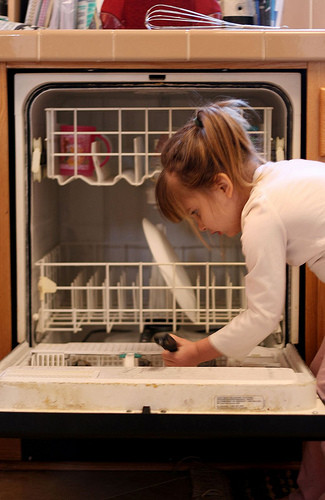
Contrary to common assumptions about adolescents, Telzer and Fuligni found that not only were daily chores not stressful, they were actually associated with greater well-being: The kids who spent more days and more time helping their family reported greater feelings of happiness than did kids who tended to help less.

However, adolescents who helped parents with official or work-related issues, such as filling out government forms, actually reported greater feelings of distress, like feelings of uneasiness and discouragement.

The authors uncovered strong evidence that adolescents felt happier when they helped around the house because they thought they were filling an important role within their family. These findings resonate with previous research that has shown that when a person is established in a social group such as a family, they develop affectionate feelings toward that group and a greater willingness to help it. And when they feel valued by their group, they tend to experience more feelings of self-worth and happiness. Telzer and Fuligni surmise that helping around the house gives adolescents that sense of belonging.

“Assisting the family appears to provide adolescents with the assurance that they are fulfilling their role as a good son or daughter,” they write, “which, in turn, is associated with feelings of happiness and positivity, a sense of identity, and connection to the family.”

Tracker Pixel for Entry


About The Author

Joy Suzanne Grazer is a Greater Good editorial assistant.


Like this article?

Here's what you can do:

Donate


Meaningful work and authentic responsibility is vitally important (and too often missing) in the lives of young people. Studies have found that having chores in childhood tends to be associated with adult success. 

I write about the skills gained and relationships built when young people are part of household and community work in my recent book Free Range Learning.

Laura Grace Weldon | 9:13 am, June 24, 2010 | Link

 
blog comments powered by Disqus
 

Most...

  
  • Why Compassion in Business Makes Sense

    April 15, 2013

    Emma Seppala explains how compassionate workplaces are good for employee health and the corporate bottom line.

  • How to be a Happy Working Dad, Part One

    March 27, 2013

    A new report finds that fitting work with family isn't just a women's issue. Jeremy Adam Smith offers 10 tips for helping fathers to navigate a changing landscape at home and on the job.

  • When Getting Angry Makes You Happy

    April 2, 2013

    A new study shows how seeking happiness at the right time may be more important than seeking happiness all the time.


Greater Good Events

Greater Good Summer Institute for Educators
University of California, Berkeley
Clark Kerr Campus
Friday, June 28 - Wednesday, July 3, 2013


Greater Good Summer Institute for Educators

The GGSC’s six-day Summer Institute will equip educators with social-emotional learning tools that will benefit both students and teachers. Registration is now closed.


» ALL EVENTS


Take a Greater Good Quiz!

How compassionate are you? How generous, grateful, or forgiving? Find out!

» TAKE A QUIZ
 

Dr. Christine Carter's blog on the science of raising happy kids.

» READ MORE
 

Watch Greater Good Videos

Jon Kabat-Zinn

Talks by inspiring speakers like Jon Kabat-Zinn, Dacher Keltner, and Barbara Fredrickson.

Watch
 

Greater Good Resources


» MORE STUDIES
 
 
» MORE ORGS
 

Book of the Week

Why We Cooperate By Michael Tomasello Nature and nurture interact to inform, and reform, cooperative behavior. Infants and apes are both able to share, but only the two-year-old will pick up that thing you dropped in front of her.

» READ MORE
 
Is she flirting with you? Take the quiz and find out.
image

Sponsors

The Quality of Life Foundation logo Special thanks to

The Quality of Life Foundation for its support of the Greater Good Science Center

 
"Greater Good offers a first-rate service to those who want to track new and important research findings in social and emotional intelligence."  
Daniel Goleman

Best-selling author,
Emotional Intelligence and Social Intelligence
(www.danielgoleman.info)